An Experienced Handwriting Analysis Expert
I am Vikas Arora, a clinical graphologist and the founder of TheGraphology.com. As a dedicated biometric behavioral specialist, I analyze the neuromuscular output of your ink to bypass the conscious ego, map your true emotional intelligence, and deploy targeted neuroplastic interventions to permanently rewire your psychological operating system for absolute success.
Drawing on decades of experience as a content strategist and a lifelong dedication to self-improvement and personality development, I have spent my career mastering the art of uncovering hidden patterns. My analytical mindset was heavily shaped by years of tracking highly complex and volatile systems—from the nuances of the Indian stock market to the intricate movements of the crude oil and natural gas sectors.
In these high-stakes environments, success requires the ability to look past the obvious and read the underlying data. I apply this exact same rigorous, analytical approach to the study of human behavior through handwriting.
The End of the Self-Help Treadmill
You have likely spent years searching for the right formula to unlock your potential. You have consumed countless self-help books, recited daily affirmations, and perhaps even hired mindset coaches to help you break through your invisible ceilings.
For a fleeting moment, you feel motivated. Then the market shifts, a personal crisis hits, or a high-stakes corporate negotiation goes south, and you instantly revert to the exact same self-sabotaging habits you thought you had conquered.
Why? Because traditional self-improvement relies entirely on conscious willpower, and willpower is a finite resource. When you are under extreme stress, your brain abandons motivation and defaults to its deepest, most deeply ingrained neural pathways.
You cannot out-think a terrified central nervous system.
You need a handwriting analysis expert who does not deal in horoscopes or generalized platitudes, but in hard, biometric data.
When you drag a pen across unlined paper, your brain bypasses your heavily curated public mask. It transmits your exact emotional state, your hidden traumas, your true leadership capacity, and your baseline resilience directly into your fingertips.
I read the friction in that ink. Welcome to the clinical science of graphology. It is time to meet your actual self.
Why the Corporate and Personal Worlds Need an Authority?
When high-achievers land on this page, they are executing a deep commercial investigation. You are not looking for entertainment; you are looking for an empirical edge. Or you are an executive trying to understand why you micromanage your team into the ground.
You are a founder trying to vet a prospective business partner before handing over equity. Or you are an individual desperately trying to understand why your romantic relationships continuously detonate at the one-year mark. You demand a subject matter expert who can provide a verifiable, data-driven framework to mitigate these risks.
Why Pop Psychology is Failing You in 2026?
To understand my methodology, we must first aggressively tear down the outdated frameworks currently failing you.
The Delusion of the “Online Personality Assessment“
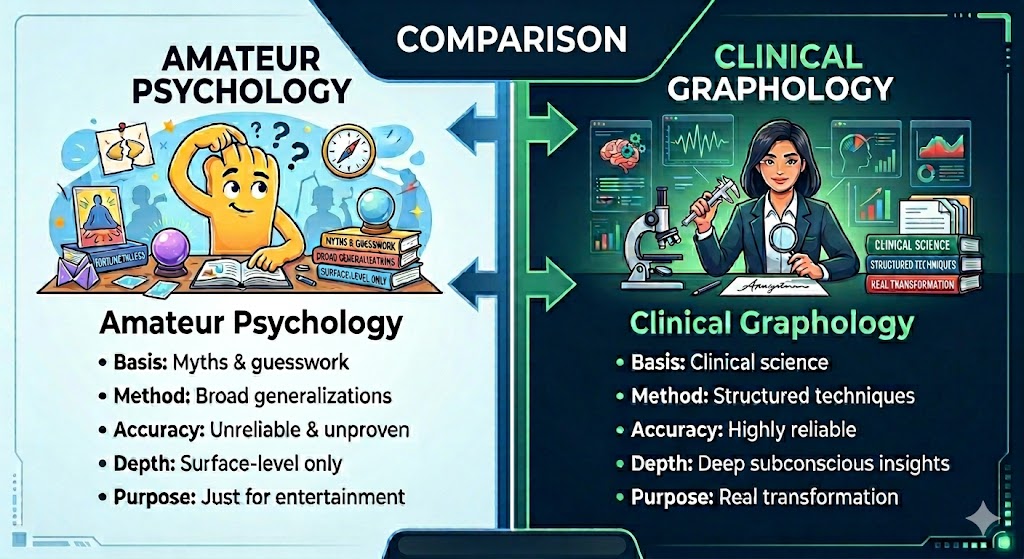
The corporate and dating worlds are addicted to self-reported psychometric tests. These algorithms are fundamentally broken because they rely on your ego holding the mouse.
A highly narcissistic executive knows exactly which bubble to fill in to appear “empathetic and collaborative.” These tests measure your ability to game a system. They do not measure reality.
The “Neat Handwriting” Myth:
The internet is flooded with amateur blogs equating beautiful calligraphy with a healthy personality. This is a dangerous oversimplification. In my clinical experience, a flawlessly “perfect,” rigid script often belongs to a personality paralyzed by anxiety, suffocating under the pressure to maintain an external facade.
The AI Scanner Trap:
Many tech companies are selling instant AI handwriting analysis. An algorithm can measure the geometry of a slant, but it cannot synthesize human contradiction.
It cannot understand the profound friction of an individual who possesses the heavy, aggressive pen pressure of a dictator but the terrified, retreating slant of a traumatized introvert.
I do not feed your intimate biometric data into a machine. In fact, I manually map, synthesize, and evaluate the tactile friction of your ink. I treat your handwriting as a biometric polygraph.
From Market Volatility to Human Neurology
My journey to becoming the premier clinical graphologist at www.thegraphology.com was not born out of mysticism; it was forged in the fires of hardcore data analysis and high-stakes market volatility.
Before I mapped the complexities of the human subconscious, I spent years mapping financial markets. I spent thousands of hours analyzing the aggressive, unpredictable swings of the Sensex, dissecting the psychological panic embedded in Nifty and Bank Nifty options chains, and tracking the ruthless, macro-economic supply lines of global crude oil and natural gas markets.
In the trading trenches, I learned a fundamental, undeniable truth:
Human emotion drives all data.
You can build the most sophisticated algorithmic trading model in the world, but when a sudden geopolitical shock hits the crude oil market, or when a sudden policy shift rocks the Bank Nifty, logic evaporates.
Fear and greed take over. The charts I analyzed every day were not just numbers; they were visual representations of mass human psychology—the visual footprint of panic, resilience, hesitation, and aggressive momentum.
I realized that to truly predict the market, you had to predict the human mind. But how do you measure the mind of a single individual when they are sitting across from you in a boardroom, carefully hiding their true intentions behind a tailored suit and media training?
That realization led me to clinical graphology.
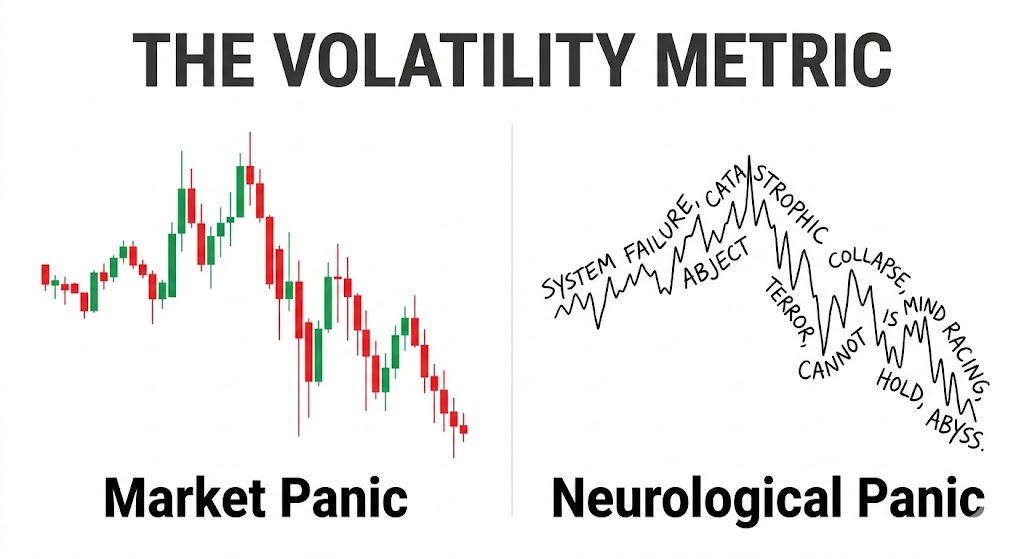
I took the exact same rigorous, emotionless, data-driven analytical framework I used to decode natural gas and stock market volatility, and I applied it to ink. Just as a skilled trader reads the erratic candlesticks of a volatile stock chart to predict price action, I read the erratic baselines and pressure dynamics of your handwriting to predict behavioral action.
I am not a therapist who asks you to verbalize your feelings. Actually, I am a behavioral analyst. I extract the data your brain leaves on the page, synthesize the variables, and provide you with a high-leverage strategy to correct your course.
Breaking the Language Barrier in Self-Help
My deep passion for the self-help movement is rooted in practical execution. Motivation is useless without the mechanics to sustain it. However, I recognized early on that profound psychological insights are often locked behind academic jargon or restricted by language barriers.
I have dedicated myself to making this biometric science universally accessible. I regularly break down complex self-help concepts, neuroplasticity, and clinical graphology principles through extensive, high-value articles published in both English and Hindi.
The central nervous system does not care about what language you speak—the friction of your pen pressure and the trajectory of your baseline are universal human outputs. By writing across languages, I ensure that world-class psychological development is available to anyone willing to put a pen to paper.
The Three Pillars of My Clinical Practice
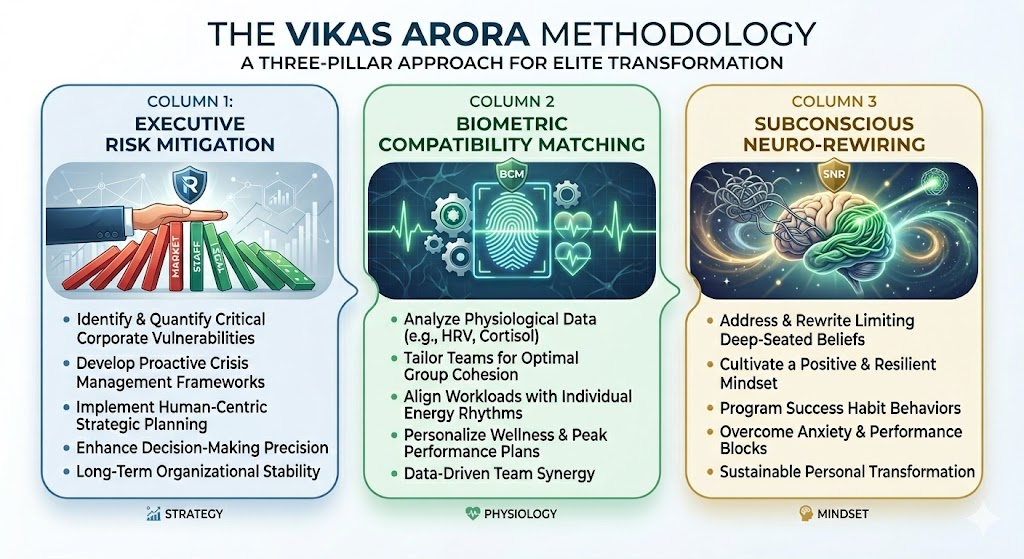
Pillar 1:
Executive & Corporate HR Screening
The corporate world hemorrhages millions of dollars annually due to toxic hires. Executives are brilliant actors during the interview process.
The Problem:
You cannot accurately assess an executive’s stress tolerance, integrity, or empathy through a 360-degree interview panel. Narcissists and sociopaths are exceptionally skilled at charming hiring committees.
My Intervention:
I conduct advanced biometric audits for enterprise clients. By analyzing a final-stage candidate’s spontaneous handwriting, I bypass their rehearsed answers. I measure their “T-bars” to gauge genuine ambition versus imposter syndrome.
Moreover, I analyze their baseline trajectory to detect hidden burnout. I look for the “Double-Looped O” to expose chronic deception and paranoia. I provide boards and Private Equity partners with an unvarnished psychological blueprint of who they are actually hiring.
Pillar 2:
Relationship & Compatibility Audits
The “honeymoon phase” is built on a cocktail of dopamine and a subconscious suppression of toxic traits. Eventually, the mask slips.
The Problem:
Couples counseling often devolves into an ego-driven battle of who is “right,” with both partners verbally manipulating the narrative. Standard compatibility quizzes are easily gamed.
My Intervention:
I execute joint biometric compatibility audits. Actually, I do not look for identical handwriting—that breeds stagnation. I map the emotional thermostats of both partners. If a highly expressive, emotionally driven partner (heavy right slant) marries a fiercely logical, compartmentalized partner (vertical print), resentment is inevitable without intervention.
I map the exact friction points, expose absolute dealbreakers (like the “Felon’s Claw” of self-sabotage), and provide the biometric data required to depersonalize conflicts and rebuild communication.
Pillar 3:
Personal Handwriting Reports
You cannot defeat an enemy you cannot see. Most professionals are actively fighting their own nervous system.
The Problem:
You suffer from procrastination, a fear of success, or an inability to command authority, but you do not know why. You feel an inexplicable gap between your potential and your execution.
My Intervention:
I generate deeply comprehensive Personal Handwriting Reports. I measure the discrepancy between your signature (your public mask) and your standard script (your private reality).
When I find the pathological stroke causing your pain—whether it is the retreating left slant of past trauma or the microscopic sizing of crushed self-esteem—I do not just point it out. I prescribe Graphotherapy.
Case Studies from the Desk of an Expert
Theory is meaningless unless it generates absolute ROI. Here are synthesized, anonymized case studies from my clinical files that demonstrate the undeniable power of this science.
Case Study 1:
The Fund Manager’s Paralysis
A managing director of an equities trading firm reached out to me. His top portfolio manager—a man who had historically generated massive returns trading Bank Nifty options—had suddenly lost his edge.
Though his technical analysis was still flawless, but he was hesitating on critical trades, missing massive market opportunities, and losing the firm millions. His standard performance reviews showed no issues.
I requested a spontaneous handwriting sample from the manager, along with a historical sample from his hiring date three years prior.
The Clinical Verdict:
The historical sample featured a firm, slightly ascending baseline and sharp, decisive terminal strokes. His current sample was entirely different. His baseline was violently erratic—jumping up and down like a volatile options chart—and the terminal strokes of his words hooked aggressively backward.
My Analysis:
I delivered the report to the director. The intense, daily pressure of the Indian stock market had finally fractured the manager’s central nervous system.
He wasn’t lacking data; he was suffering from acute decision fatigue and an overwhelming subconscious fear of making a catastrophic financial mistake. The backward-hooking strokes were the biometric footprint of paralyzing hesitation.
The Rewiring:
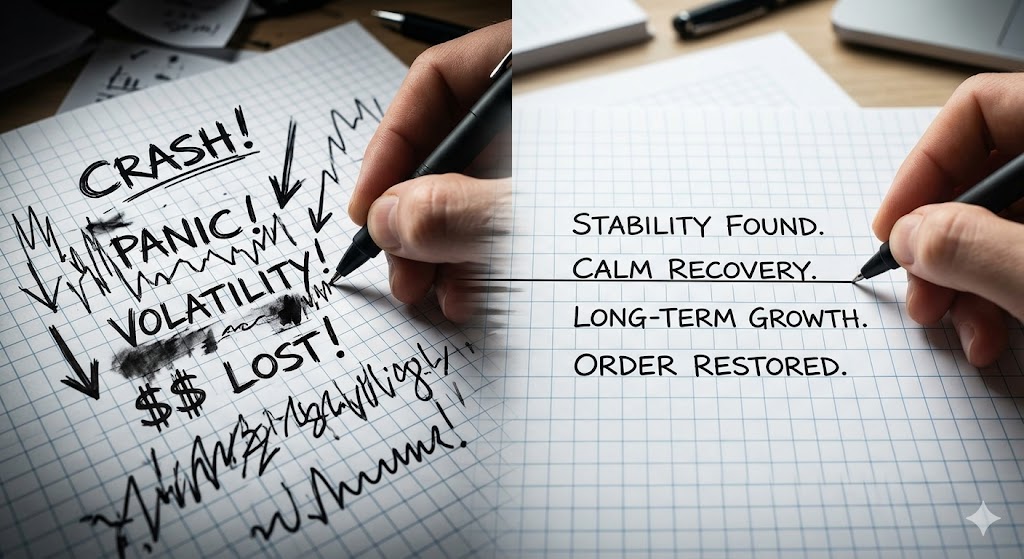
We implemented a strict 30-day graphotherapy protocol aimed at stabilizing his baseline. By physically forcing his hand to execute firm, straight, forward-moving baselines for 15 minutes a day, we stabilized his autonomic nervous system. We bypassed his conscious anxiety. Within six weeks, his trade execution velocity returned to peak, fearless levels.
Case Study 2:
The Toxic Founder Erasing His Own Acquisition
A private equity firm was poised to acquire a rapidly scaling company. They loved the founder’s pitch deck, but as part of their advanced due diligence, they requested a biometric audit.
The Clinical Verdict:
The founder’s signature was massive, projecting intense public confidence. However, his regular script was microscopic, and his lowercase ‘o’s contained tight, double-looped knots.
Most dangerously, his signature featured a heavy “strikethrough”—a line drawn aggressively straight through the center of his own name.
My Analysis:
I informed the PE firm that this founder was a deeply paranoid, highly secretive micromanager. The double loops indicated a chronic tendency to withhold critical financial truths.
The strikethrough was the ultimate red flag: it is the graphological equivalent of self-cancellation. The founder subconsciously loathed himself and would inevitably sabotage the company just as the acquisition crossed the finish line.
The Aftermath:
The firm dug deeper into the company’s internal communications based on my warning. They discovered a massive, hidden retention crisis among the senior engineering team, entirely caused by the founder’s abusive micromanagement.
The acquisition was restructured to immediately remove the founder from operations. The ink saw the toxicity months before the balance sheet did.
The Science of Graphotherapy
Identifying your flaws is only 50% of my job. As a handwriting analysis expert, my ultimate value lies in the intervention.
When you read traditional self-help material, you are engaging your conscious mind. But your defense mechanisms live in your subconscious. This is why you cannot simply “decide” to be confident if your amygdala is constantly firing fear signals.
Graphotherapy is the clinical process of permanently altering your core behavioral traits by rewiring your central nervous system through targeted handwriting exercises.
Because your brain dictates the micro-movements of your hand, the biological connection is entirely bi-directional. By consciously forcing your hand to repeatedly execute a specific, unfamiliar motor pattern, you send new kinetic and tactile data back to your brain.
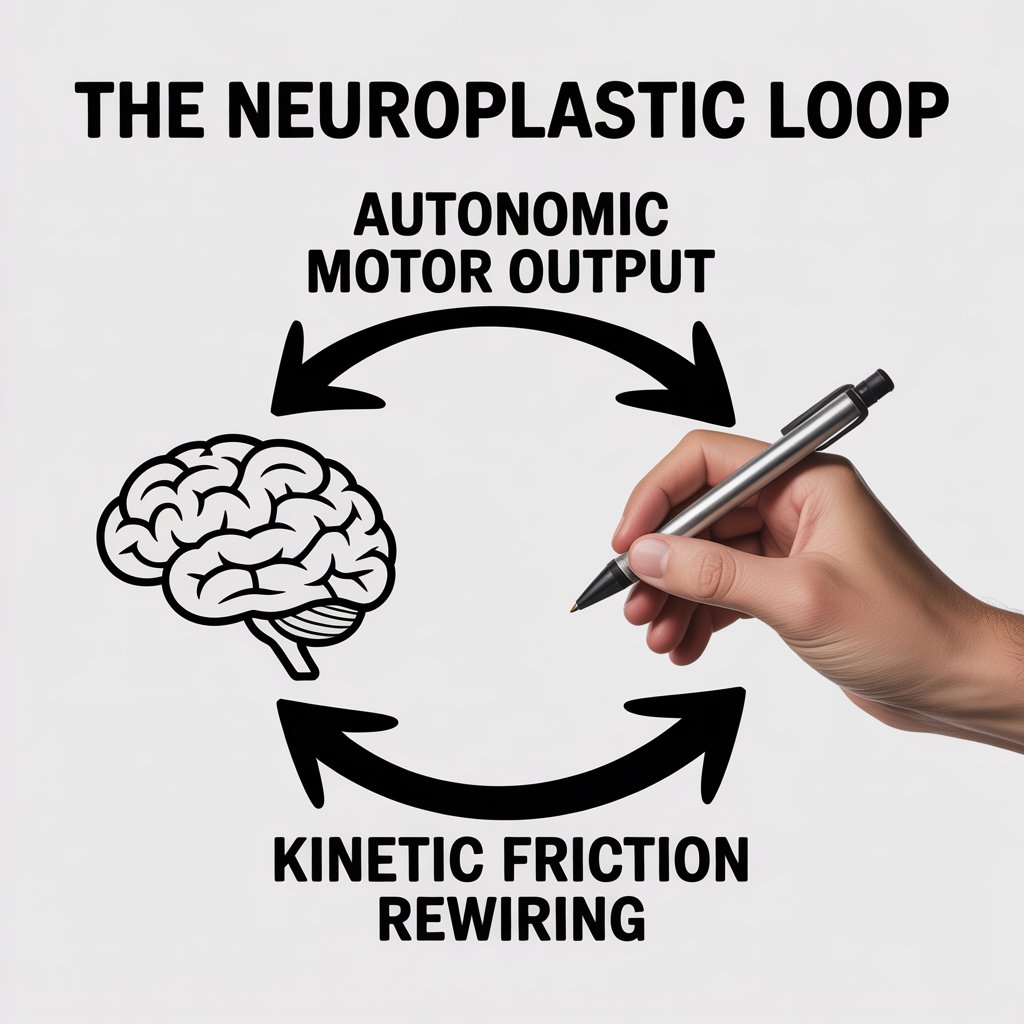
If my analysis reveals that your low “t-bars” are causing severe imposter syndrome, I do not tell you to shout affirmations in a mirror. I prescribe a specific, physical handwriting exercise. I force you to cross your t-bar high on the stem with firm, decisive pressure.
You must practice this newly engineered stroke for 15 minutes a day, using a ballpoint pen on unlined paper, entirely uninterrupted. The mental friction and physical discomfort you feel during the first week is the literal sensation of old, self-limiting neural pathways dying.
But by day 30, the new stroke becomes autonomic muscle memory. The corresponding psychological shift—elevated self-worth, increased stress tolerance, eradicated hesitation—becomes a permanent, default part of your identity. I do not just read your mind. I give you the pen to rewrite it.
My Step-by-Step Diagnostic Framework
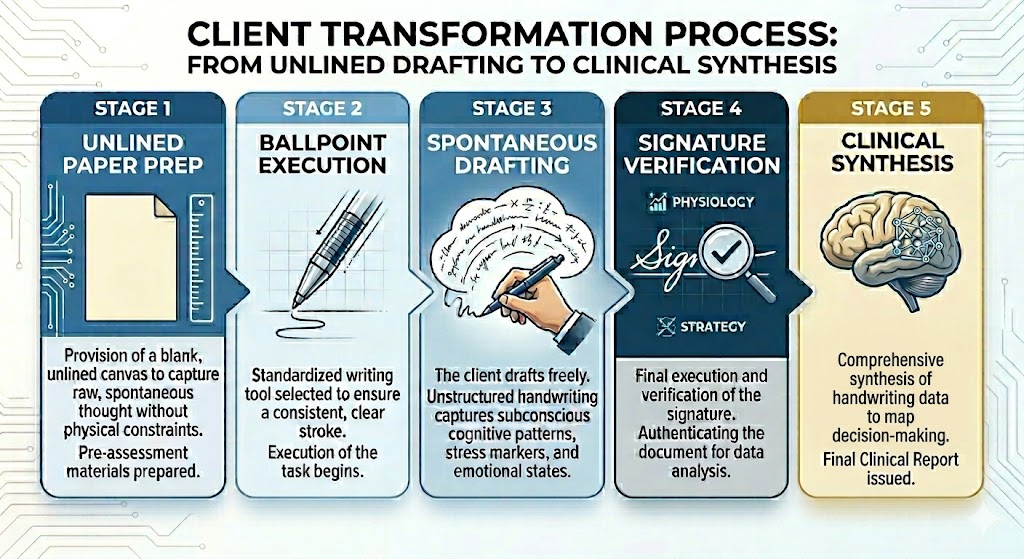
You cannot reinvent your public identity or salvage a failing marriage by aimlessly doodling on a digital tablet. Neuroplasticity requires clinical precision, analog repetition, and strict operational protocols. Here is the exact framework I mandate for every client at www.thegraphology.com.
Step 1:
The Unlined Canvas Extraction
To extract your true neurological output, I must remove all artificial boundaries.
- The Mandate: You must provide a full-page, spontaneous handwriting sample on completely blank, unlined A4 or Letter-sized paper. Lined paper forces your brain to conform to a pre-set societal rule, completely masking your natural spatial organization, your boundaries, and your emotional baseline.
Step 2:
The Analog Integrity Protocol (Ballpoint Only)
The physical tool dictates the quality of the biometric data.
- The Mandate: The sample must be executed with a standard, medium-point ballpoint pen. Fountain pens, gel rollers, and felt-tip markers absorb effortlessly into the paper. This completely destroys my ability to measure pen pressure, which is the vital biometric metric for assessing your energy levels, physical vitality, libido, and internal anger.
Step 3:
The Distracted Narrative
The conscious ego must be distracted so the subconscious can take over the pen.
- The Mandate: Do not copy text from a book or write dictated sentences. Copying utilizes a completely different part of the motor cortex and invalidates the emotional baseline. Write a spontaneous narrative about a recent business challenge, your philosophy on life, or your long-term goals. Let your mind wander into the content so your hand operates on autopilot.
Step 4:
The Dual Signature Verification
I must measure the gap between who you are and who you pretend to be.
- The Mandate: Always sign the bottom of the page exactly as you would a legal contract. I calculate the structural differential between your standard script (your private reality) and your signature (your public mask) to determine your level of internal authenticity and expose any “Persona Gaps.”
Step 5:
Clinical Expert Synthesis
Once your analog sample is securely submitted, the real work begins.
- The Mandate: I manually measure, contextualize, and evaluate over 100 distinct micro-movements in your ink. I cross-reference slant, pressure, spatial dynamics, and pathological markers to build a flawless psychological blueprint.
Why Partner with Vikas Arora?
The internet is saturated with self-proclaimed gurus, generic astrology charts, and novelty automated AI handwriting apps that spit out contradictory horoscopes for five dollars.
If you are a junior employee looking for five minutes of entertainment, those apps are perfectly fine.
But if you are a high-achiever managing a massive corporate career, navigating a complex marriage, vetting a million-dollar startup founder, or trying to break a cycle of generational trauma, relying on an algorithm to diagnose a human subconscious is incredibly reckless. An algorithm measures basic geometry. It cannot measure psychological friction.
I operate at the absolute apex of biometric psychological assessment. Actually, I do not outsource your intimate data. I map the exact friction in your subconscious, identify the toxic blind spots your board or your spouse is afraid to tell you about, and I hand you the definitive, unvarnished truth.
You spend thousands of hours optimizing your stock portfolios, your supply chains, and your physical health. It is time to optimize the root code of the human operating all of them.
Stop guessing about who you are. And stop repeating the same toxic relationship cycles. Let me read the ink, and together, we will engineer your reality.
Frequently Asked Questions
How does a handwriting analysis expert differ from a standard therapist?
We serve completely different, yet complementary, purposes. Traditional talk therapy relies entirely on verbal communication, which is filtered through your ego, defensiveness, and a subconscious desire to protect your self-image.
As a clinical graphologist, I completely bypass your ego. I measure involuntary neuro-motor outputs, providing a 100% objective, biometric baseline of why you are struggling in the first place, drastically accelerating the effectiveness of any subsequent coaching or therapy.
Can you intentionally disguise your handwriting to fool an expert?
It is biologically impossible to maintain a disguised script for more than a few sentences. Writing is a deeply ingrained neuromuscular habit.
While a highly intelligent executive might consciously alter their slant or try to write “neater” for the first paragraph, cognitive load inevitably takes over as they focus on the actual content of the narrative. By the middle of the page, their natural, subconscious neuro-motor patterns bleed through. The ink never lies for long.
Why do you insist on using unlined paper and a ballpoint pen?
Lined paper acts as an artificial boundary. When you write on printed lines, you are forcing your brain to conform to a pre-set rule, which masks your natural spatial organization and your true emotional baseline (whether you naturally write upward with optimism or downward with burnout).
A standard ballpoint pen is mandated because it requires physical friction to leave ink. This allows me to measure your pen pressure—the exact metric of your emotional vitality and stress tolerance—which gel pens and markers destroy.
Can an expert analyze my signature if I sign it on an iPad or tablet?
While I can observe basic spatial geometry from a digital signature, a stylus on a glass screen provides zero kinetic friction. It completely strips away pen pressure.
For a true, highly accurate clinical audit of your executive identity or personal psychology, I must analyze a wet-ink sample executed with a standard ballpoint pen on paper. The analog friction is non-negotiable for biometric accuracy.
Does my handwriting change over time, and what does that mean?
Your handwriting must change, because your neurological state changes. While your core neuro-motor mechanics remain relatively stable, your script constantly fluctuates based on immediate physical fatigue, emotional trauma, market stress, or personal growth.
An analysis captures a hyper-accurate, biometric snapshot of your exact psychological state at the moment the pen touches the paper, making it the ultimate real-time diagnostic tool.
Can handwriting analysis predict my future success or failure?
Graphology is not fortune-telling; I cannot predict if you will win the lottery or exactly what day your company will go public. However, I can accurately map the behavioral traits that lead to those outcomes.
I can definitively identify if you possess the relentless ambition, strategic logic, and emotional resilience required to build a business empire, or if your subconscious fear of success will cause you to sabotage a future promotion.
Is graphotherapy actually permanent for adults?
Yes. Graphotherapy relies on the scientifically proven principles of neuroplasticity. While children have highly plastic brains, adults retain the biological ability to rewire neural pathways until the end of their lives.
Once the 30-day strict analog practice period locks the new, optimized handwriting trait into your autonomic nervous system, the corresponding behavioral shift becomes muscle memory. It becomes your natural, default state without requiring continuous conscious willpower.
What happens if my handwriting is completely messy and illegible?
I do not judge aesthetics; I evaluate friction. “Messy” handwriting often belongs to highly intelligent, fast-paced thinkers whose cognitive processing speed simply outpaces their hand’s mechanical ability.
However, if your handwriting is deliberately illegible (especially in your signature or the middle zone), my analysis will flag this as a subconscious defense mechanism indicating extreme secrecy and a desire to evade accountability.
Does it matter if I write in cursive or disconnected print?
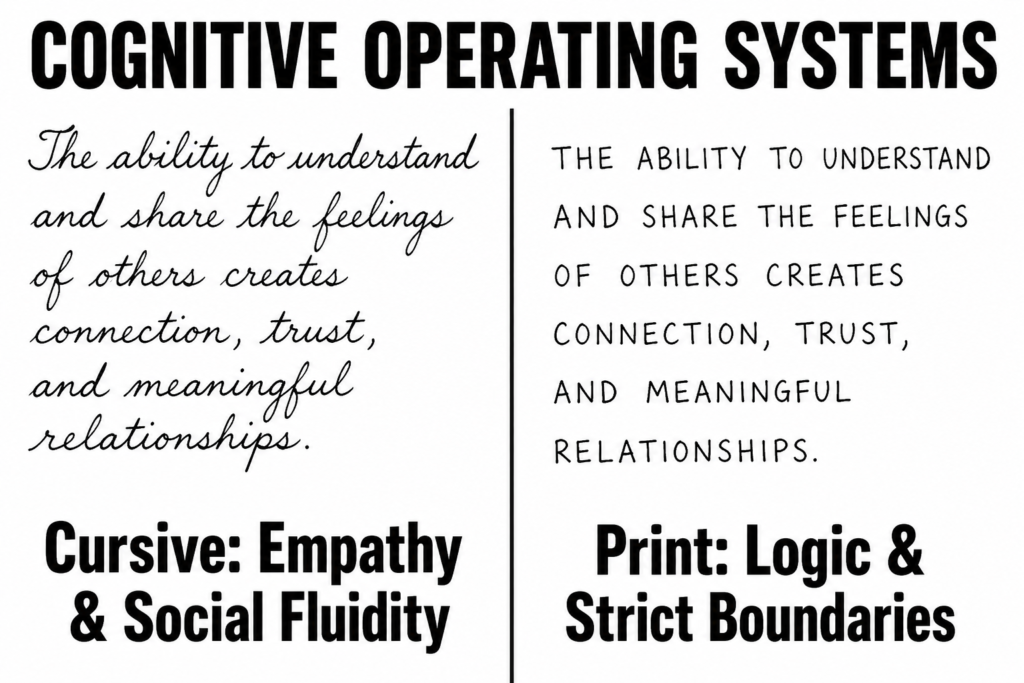
Both styles are perfectly valid but reveal entirely different cognitive operating systems. Cursive (connected) writing indicates a brain wired for social fluidity, empathy, and the seamless integration of ideas.
Print (disconnected) writing reveals a fiercely independent, highly analytical thinker who compartmentalizes their emotions and demands strict operational boundaries. My analysis details exactly how your specific style impacts your career and your relationships.
Why should I hire a clinical handwriting analysis expert instead of just taking a personality test?
As a clinical handwriting analysis expert, I do not rely on your self-awareness. Personality tests (like MBTI or DiSC) require you to answer questions about yourself, meaning your conscious ego filters the results. You will naturally answer how you want to be perceived.
I read your involuntary neuro-motor output. The ink bypasses your ego entirely, revealing the unvarnished, biometric truth about your hidden defense mechanisms and actual emotional intelligence.
Can you analyze my handwriting if I write in Hindi or another language?
Absolutely. The central nervous system does not process the biomechanics of Hindi, English, or Spanish differently. I analyze universal spatial outputs—such as pen pressure, baseline trajectory, zone proportions, and the kinetic tension of the stroke—not specific vocabulary or grammar.
Because human neurology is universal, I can accurately map your psychological operating system regardless of the specific linguistic alphabet you use.
Does being left-handed alter the accuracy of your clinical profiling?
Not at all. This is a persistent amateur myth. I measure the neurological output of your brain, not the mechanical limitations of your hand.
Whether you are left-handed, right-handed, or ambidextrous, your central nervous system dictates the spatial arrangement, baseline trajectory, and stroke tension in the exact same measurable way. The biometric data remains 100% identical.
How do we work together if I am located in a different country?
The analog requirement does not hinder global talent acquisition or personal development. You simply execute the spontaneous writing sample on unlined paper with a ballpoint pen in your remote location, scan the document in high resolution (minimum 300 DPI), and upload it via a secure portal.
I extract flawless biometric data from high-quality digital scans, allowing me to audit and rewrite the operating systems of clients worldwide.
Why do I feel mental resistance or hand cramps when starting graphotherapy?
That physical discomfort is the hallmark of active neuroplasticity. When I prescribe a new, optimized stroke that opposes your current psychological state, your central nervous system fights back.
The hand cramps, frustration, and mental fatigue you feel during the first 72 hours of practice are the literal sensation of old, self-limiting neural pathways dying. You must push through the friction until the new stroke becomes autonomic muscle memory.
Can you analyze my child’s handwriting to help predict their ideal career?
I do not perform clinical audits on young children. Before the age of 14, a child’s neuro-motor pathways and fine motor skills are still in primary development, and they are largely mimicking the handwriting models taught in school.
I only conduct advanced biometric profiling on older teenagers and adults, once their central nervous system has fully locked into an individualized, mature baseline.
Do you only work with C-suite executives and enterprise corporations?
While enterprise risk mitigation and executive screening are core pillars of my practice, I work with any high-achiever who is serious about permanent evolution.
Whether you are a founder trying to vet a partner, an individual trying to break toxic relationship cycles, or a professional fighting crippling imposter syndrome, my biometric framework applies. If you are willing to confront the truth in your ink, I will build your blueprint.
How long does it take for you to manually synthesize my psychological profile?
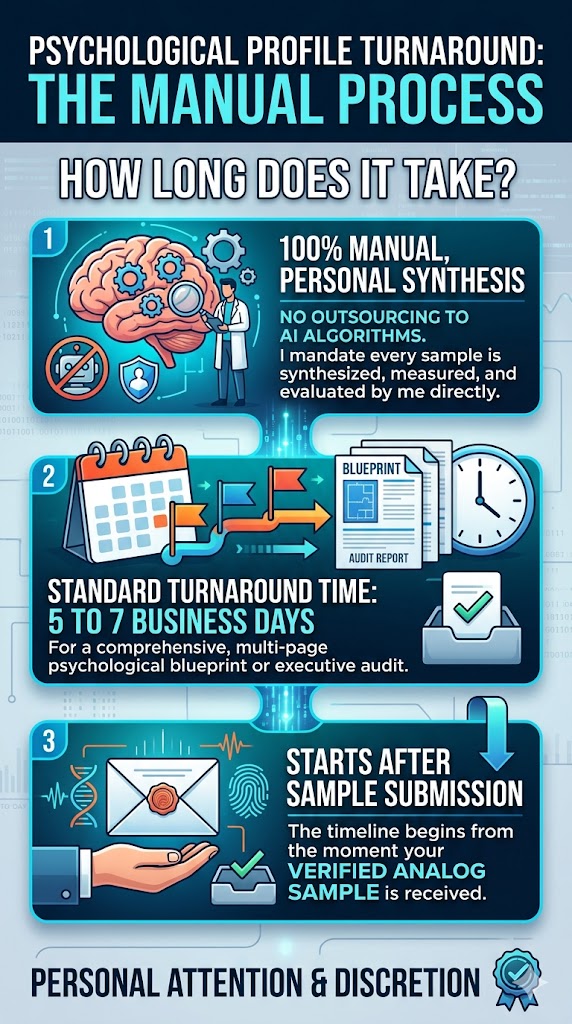
Because I absolutely refuse to outsource your intimate biometric data to automated AI algorithms, I mandate that every single sample is manually synthesized, measured, and evaluated by me directly.
The standard turnaround time for a comprehensive, multi-page psychological blueprint or executive audit is typically 5 to 7 business days from the moment your verified analog sample is submitted.