Imagine you walk into a crowded coffee shop. There is a large table right in the center of the room, surrounded by people, and a small, quiet booth tucked away in the very back corner. Where do you sit?
Your choice in that coffee shop is dictated by your internal need for personal space—a psychological concept known as “proxemics.” But long before you ever walk into a room, your brain is already mapping out your spatial boundaries on a microscopic level every time you pick up a pen.
In the science of graphology, a blank piece of paper is not just a surface to hold ink. The paper represents your environment. It is the world around you.
How you choose to arrange your words on that page—specifically, how much blank space you leave around the edges—is a direct, undeniable reflection of how you position yourself in society.
The margins are the walls you build.
If you are someone who naturally leaves massive canyons of white space on the left, right, top, or bottom of your page, you are actively managing your social boundaries. In this definitive guide, we are going to decode exactly what wide margins in handwriting mean.
We will explore the deep-seated psychological need for isolation, the fear of the future, the aesthetic ego, and what happens when the walls you build become too thick to breach.
The Blank Page as Your Psychological Landscape
To truly understand margin psychology, you must first understand the symbolic geography of a piece of paper. When you look at an empty page, your subconscious mind instantly divides it into a timeline and a social hierarchy.
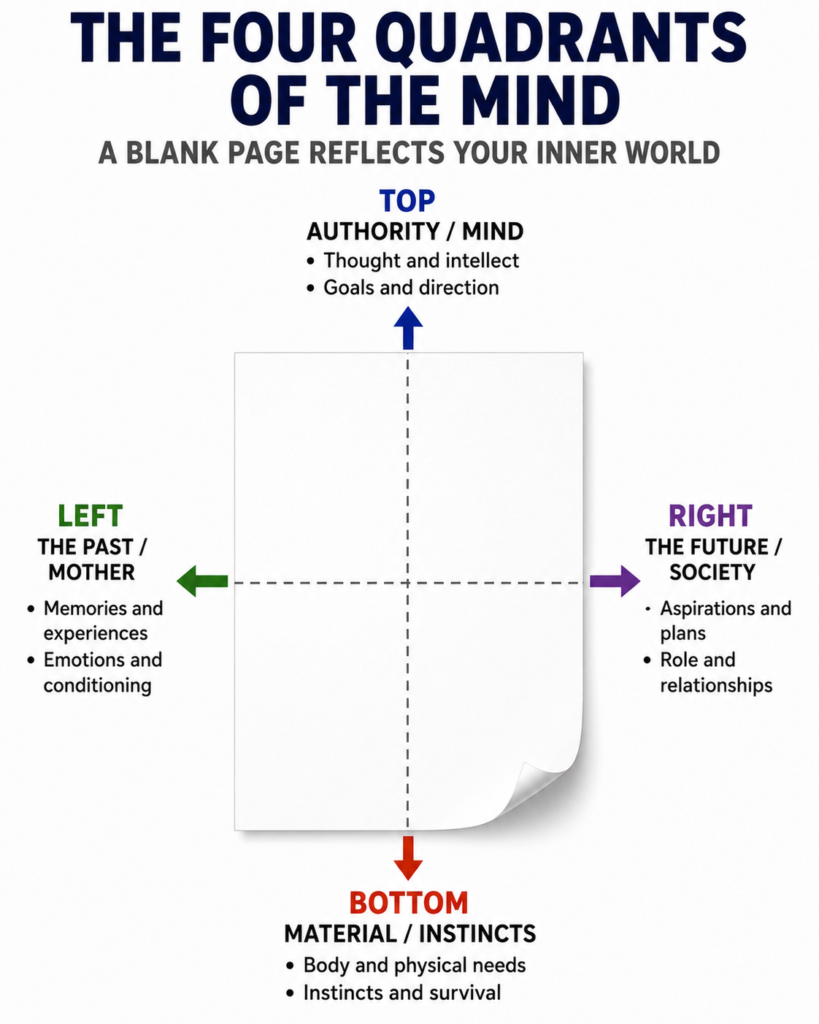
- The Left Side: Represents the past, your roots, your childhood, and the mother figure. It is where you start.
- The Right Side: Represents the future, the outside world, society, goals, and the father figure. It is where you are going.
- The Top: Represents authority figures, the intellect, spirituality, and conscious thought.
- The Bottom: Represents the material world, physical drives, practical reality, and the unconscious.
When you begin writing, your pen travels from the past (left) toward the future (right). Where you start that journey, where you refuse to go, and where you place your boundaries tells a trained graphologist exactly how you handle your life’s trajectory.
Decoding Wide Margins in Handwriting:
When we talk about the middle of the page—the text itself—we are looking at the ego and the daily life. The margins, however, are the “buffer zones.”
In the animal kingdom, a buffer zone is the physical distance a predator or prey requires to feel safe. In human psychology, it is the emotional distance we require to feel secure.
Writers who use average, moderate margins (about an inch on the left and a half-inch on the right) have a balanced buffer zone. They feel comfortable interacting with society but still maintain healthy personal boundaries.
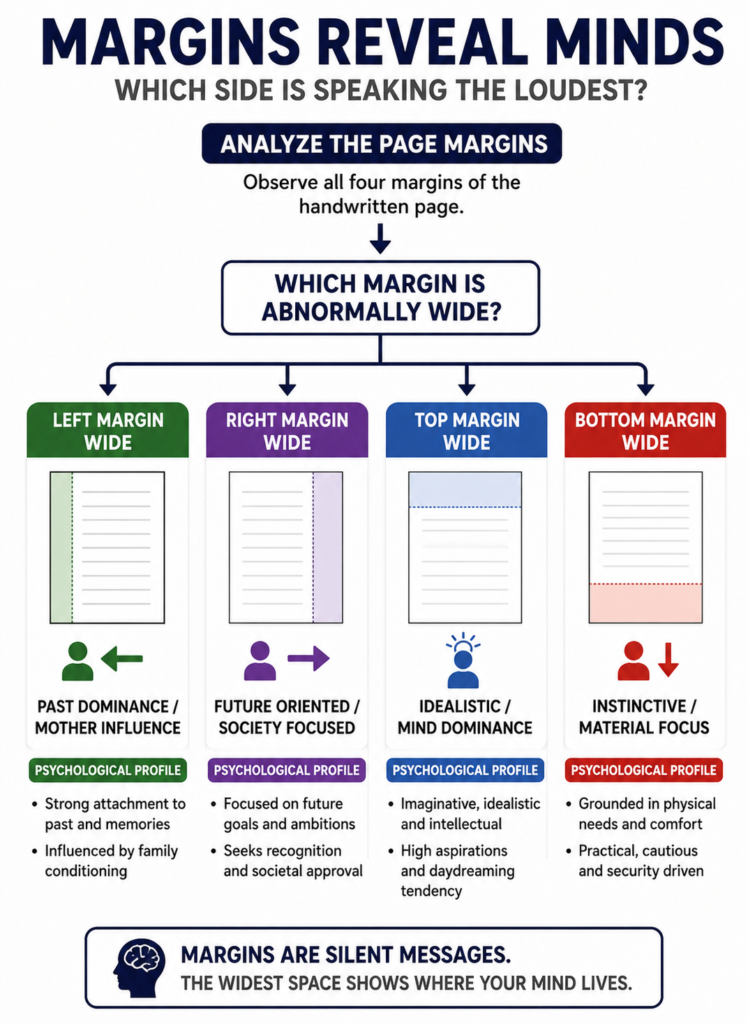
Writers who use wide margins in handwriting are amplifying that buffer zone. They are forcefully pushing the world away. But the specific side of the page where they place that massive wall reveals what they are pushing away.
The Wide Left Margin:
Running from the Past
The left margin is your starting line. Because Western writing moves from left to right, every time your hand snaps back to the left side of the page to begin a new line, you are subconsciously returning to your roots, your origin, and your past.
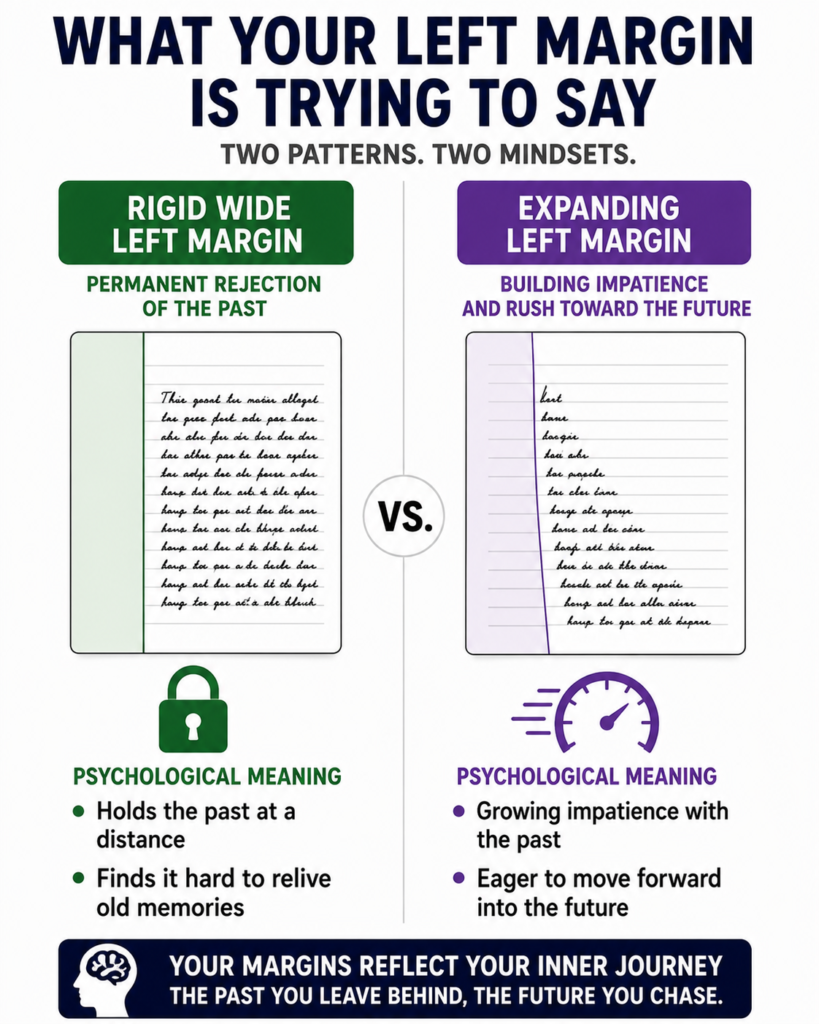
If a writer leaves an exceptionally wide left margin—sometimes starting their sentences a third of the way across the page—they are physically refusing to go back to the beginning.
1. The Need to Escape History
A massively wide left margin is the graphological equivalent of packing your bags and leaving your hometown, vowing never to return.
- The Psychology: This writer is actively rejecting their past. This could be due to a difficult childhood, a traumatic previous relationship, or simply a deep desire to reinvent themselves. They do not want to be defined by where they came from. They are fiercely looking forward.
- The Emotional Impact: While this forward momentum can fuel incredible ambition, it can also create a sense of rootlessness. They may struggle with feelings of belonging because they have deliberately severed their psychological anchor to their history.
2. The Drive for Cultural Rebellion
Often, people with extremely wide left margins are naturally rebellious. Because the left side also represents traditional societal rules (the way things have “always been done”), avoiding the left side means avoiding tradition.
- The Psychology: These individuals hate being micro-managed. They do not care how the company operated ten years ago; they only care about how to innovate for tomorrow. They are the disruptors, the independent thinkers, and the non-conformists.
3. The “Expanding” Left Margin:
A Sign of Impatience Sometimes, a left margin does not start wide, but it slowly grows wider as the page goes down. The text forms a diagonal line, sliding further and further away from the left edge.
- The Meaning: This is a classic sign of extreme eagerness and impatience. The writer is in such a rush to get to the future (the right side of the page) that their brain physically will not let their hand return all the way to the starting line. They are racing ahead of themselves, often skipping crucial details in their rush to cross the finish line.
The Wide Right Margin:
Fear of the Unknown
The right side of the paper represents the external world, the future, and other people. It is the great unknown. When you approach the right edge of the paper, you are subconsciously approaching society.
If a writer leaves a massive, gaping white space on the right side of the page—stopping their sentences long before the paper runs out—they are hitting a psychological brake pedal.
1. The Fear of the Future
A wide right margin indicates a profound hesitancy to step into the unknown.
- The Psychology: This writer is deeply cautious. They do not like taking uncalculated risks. The future feels dangerous and unpredictable, so they stay safely back from the edge. They prefer the safety of the past (the left side) to the uncertainty of tomorrow.
- The Career Impact: These individuals are not natural entrepreneurs. They thrive in secure, predictable environments with clearly defined rules. If you ask them to spearhead a completely new, untested project, they will experience immense anxiety because you are forcing them into their psychological “right margin.”
2. Social Anxiety and Introversion
Because the right side represents “other people,” avoiding it means avoiding social exposure.
- The Psychology: A person with a massive right margin is holding themselves back from full social engagement. They are highly protective of their internal world. Even when they are at a party or a networking event, they are the ones standing near the exit, keeping a safe distance from the center of the crowd.
- Relationship Dynamics: They take a very long time to commit to a relationship. Committing means stepping fully into the future with someone else, which triggers their natural defensive brakes.
3. The “Contracting” Right Margin:
Building Courage
Conversely to the expanding left margin, sometimes a right margin starts incredibly wide at the top of the page, but slowly gets narrower as the writing goes down.
- The Meaning: This is a beautiful graphological sign of someone overcoming their fear. At the beginning of the task (or the relationship), they were hesitant and kept their distance. But as they settled in and grew more comfortable, their courage expanded, and they allowed themselves to step closer and closer to the future.
The “Picture Frame” Effect:
Wide Margins on All Sides
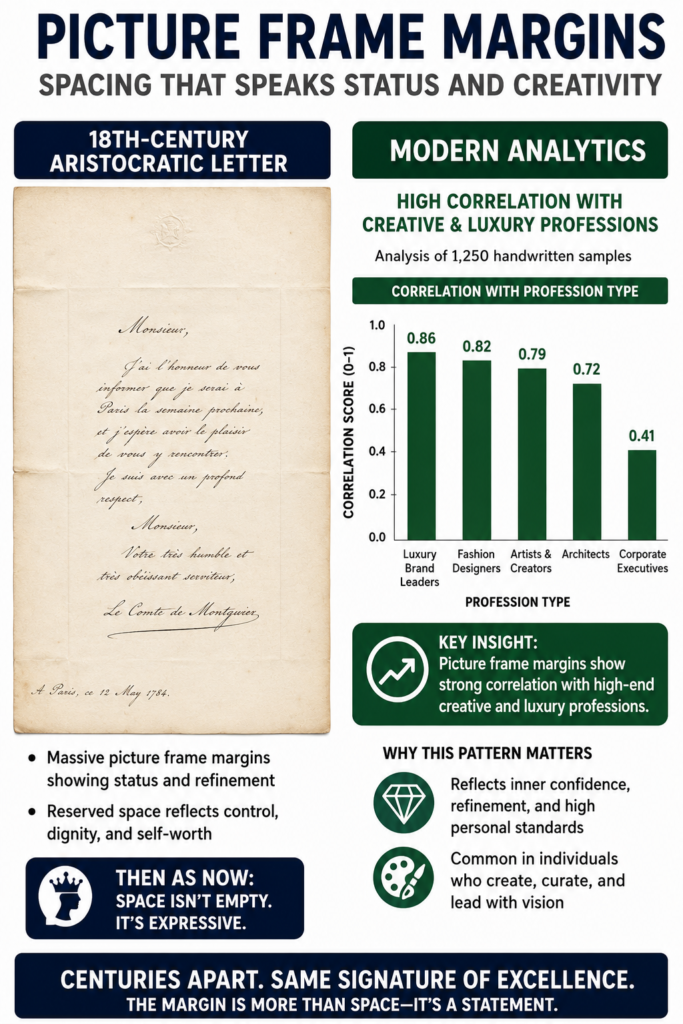
When a writer leaves massive margins on the left, right, top, and bottom, the text sits completely isolated in the dead center of the page. It looks like a small photograph surrounded by a massive, white picture frame.
This is one of the most revealing spatial arrangements in all of graphology.
The Architect of Total Isolation
The “Picture Frame” writer has built a fortress around themselves. They have rejected the past (left), refused the future (right), distanced themselves from authority (top), and disconnected from practical reality (bottom).
- The Psychology: This indicates extreme introversion, profound loneliness, or a highly developed sense of self-containment. This person feels completely alienated from their environment. They are an island. They do not rely on anyone else for emotional support, but they also do not let anyone in to offer it.
The Aesthetic Ego and the “Luxury” of Space
There is a fascinating historical context to the picture frame margin. Hundreds of years ago, paper was incredibly expensive. Only the wealthy aristocracy could afford to waste it.
Leaving massive blank spaces around a letter was a subtle flex of extreme wealth and privilege—a way of saying, “I have so much money, I do not need to use the whole page.”
- The Modern Translation: Today, graphologists recognize the “Picture Frame” as a sign of a highly aesthetic, sometimes elitist ego. This writer has impeccable taste, loves luxury, and views themselves as distinct and separate from the “common” crowd. They demand exclusivity. Their need for personal space is not just about fear; it is about maintaining a pristine, curated environment. They cannot tolerate vulgarity, messiness, or loud, chaotic situations.
Top and Bottom Margins: Authority and Grounding
While the left and right margins deal with time and society, the vertical margins deal with hierarchy and reality.
The Wide Top Margin: Distance from Authority
The top of the page represents the intellect, spirituality, and, most importantly, authority figures (bosses, parents, government).
- The Psychology: If a person starts writing halfway down the page, leaving a massive top margin, they are showing extreme deference and respect—bordering on fear—of the person they are writing to. They feel small in comparison to the recipient.
- The Exception: If they leave a wide top margin but their actual handwriting is massive and aggressive, it is not respect; it is delayed engagement. They are taking a long time to “enter the room,” forcing the reader to wait for their thoughts. It is a power play.
The Wide Bottom Margin: Fear of the Material
The bottom of the page represents the physical world, instincts, sexuality, and the grounded reality of daily life.
- The Psychology: If a writer stops writing long before they reach the bottom of the page (even when they have more to say), they are uncomfortable with the physical or material aspects of life. They might be highly intellectual or spiritual, living entirely in their heads (the top of the page), while actively avoiding the messy, practical realities of finances, physical health, or deep intimacy.
How Margin Width Dictates Professional Success
Understanding spatial management is a massive advantage in the business world. How an employee or a business partner manages their margins tells you exactly how they will manage their territory, their projects, and their clients.
Managing the “Wide Left” Employee
If you manage someone who uses massive left margins, you are managing a forward-thinker who hates the past.
- How to Lead Them: Do not ask them to audit historical data or maintain legacy systems. They will be miserable. Put them in charge of research and development, new market expansion, or creative brainstorming. Give them the freedom to run forward.
Managing the “Wide Right” Employee
If your employee leaves a wide right margin, they are terrified of the unknown.
- How to Lead Them: They are your anchors. They are fantastic at quality control, risk assessment, and maintaining stability. Do not force them to cold-call new clients or pitch untested ideas. Let them manage the systems that are already in place, where the rules are clear and the future is predictable.
The “Zero Margin” Warning Sign
What happens if you see the exact opposite of wide margins? What if someone writes from the absolute edge of the left paper, all the way to the absolute edge of the right, leaving zero white space anywhere?
- The Professional Diagnosis: This person has zero boundaries and zero concept of personal space. In an office, they are the colleague who will walk into your cubicle uninvited, talk over you in meetings, and completely monopolize the company’s time and resources. They are highly intrusive, overly talkative, and extremely frugal (they refuse to waste even a millimeter of paper).
Navigating Relationships with a Wide-Margin Writer
If you are dating or married to someone who naturally leaves massive margins on their pages, you must understand that their need for spatial distance translates directly into a need for emotional distance.
Respecting the Buffer Zone
People with wide margins are easily overwhelmed. Their nervous systems require more downtime than the average person.
- If you are an extrovert who loves to be physically close 24/7, a wide-margin partner will eventually feel suffocated. Their instinct will be to pull away (just like their pen pulls away from the edge of the paper).
- To maintain harmony, you must honor their buffer zone. Allow them to have a room in the house that is strictly theirs. Do not take it personally when they need to spend a Saturday entirely alone. By giving them the space they need, you actually reduce their anxiety, making them more likely to step closer to you when they are ready.
The Intimacy Gap
Wide right margins are particularly tricky in early dating. Because the right margin represents the future, a person who avoids the right edge is going to avoid conversations about commitment. If you push them to define the relationship too early, they will hit the brakes. You have to let them close that margin at their own pace.
Graphotherapy: Reprogramming Your Spatial Boundaries
If you are reading this and realize that your wide margins in handwriting are keeping you isolated, fearful of the future, or disconnected from reality, you can use the science of graphotherapy to physically rewrite your boundaries.
Remember, the neuromuscular connection between the hand and the brain goes both ways. If your fear dictates your margins, changing your margins can begin to alleviate your fear.
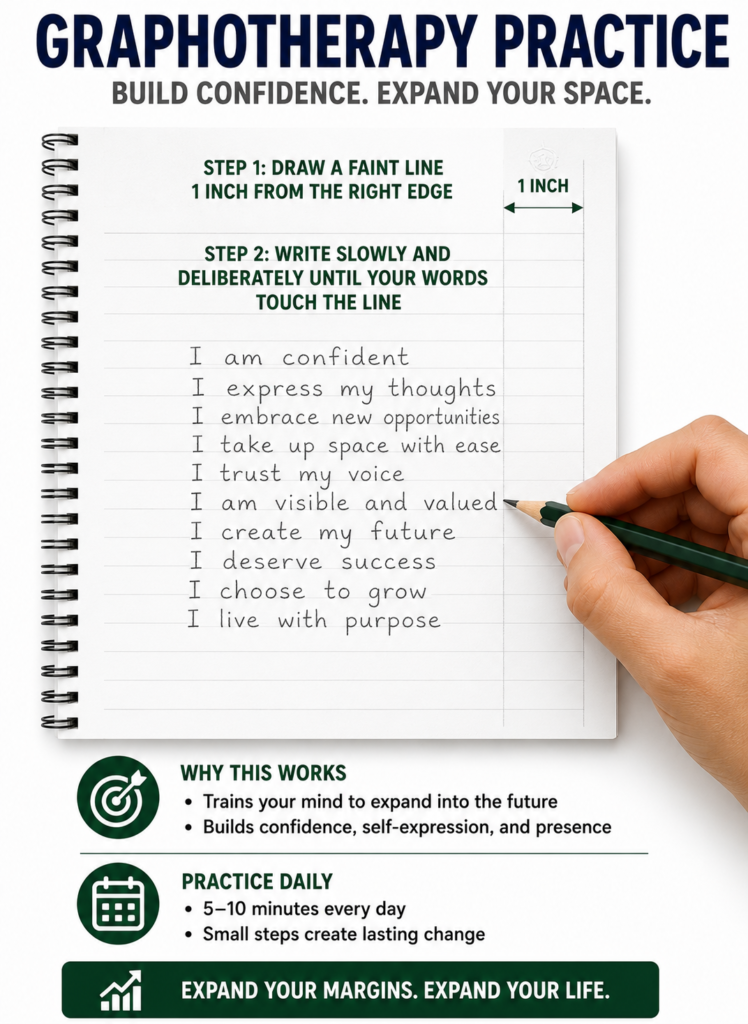
The 30-Day Margin Expansion Protocol
If you want to become more confident, more socially integrated, and less fearful of the unknown, try this targeted exercise:
- The Setup: Get a standard piece of lined paper. Do not use a computer. You need the physical resistance of the pen on paper.
- The Artificial Boundary: Take a ruler and a pencil. Draw a faint vertical line exactly one inch from the left edge of the paper. Draw another faint vertical line exactly one inch from the right edge.
- The Daily Practice: Spend 15 minutes a day writing a journal entry.
- The Rule of Contact: You must start every single line by physically touching the left pencil line. You must write until your last word touches or crosses the right pencil line. You cannot stop early.
- The Neurological Effect: If you naturally have a wide right margin, forcing your hand to reach the right edge of the paper will initially cause a spike in mild anxiety. Your brain will resist it. Push through it. By forcing your physical body to step into the “unknown” space on the page every day for 30 days, you are actively desensitizing your limbic system to the fear of the future. You are training yourself to take up space and engage with the world.
Conclusion: The Architecture of the Self
The next time you receive a handwritten letter, a signed contract, or a quick Post-it note, look past the words. Look at the silence around the words.
Wide margins are not an accident. They are the intricate architecture of the human ego. They reveal a person’s relationship with their past, their terror of the future, their respect for authority, and their desperate need for an aesthetic, isolated sanctuary.
By mastering the psychology of spatial arrangement, you gain the ability to respect the hidden boundaries of the people around you—and, more importantly, to recognize the invisible walls you have built around yourself.
Your Next Step: Grab your personal journal or a notebook you use frequently. Flip to a random page in the middle of the book. Take a ruler and actually measure your left and right margins. Are you running from the left side? Are you stopping three inches before the right? Your subconscious has drawn a map of your comfort zone. The only question now is: are you willing to step outside of it?
One response
This article was a massive eye-opener. I immediately grabbed my old journals like you suggested at the end. I don’t just have a wide left margin; I have the “Expanding Left Margin.” My writing literally forms a diagonal line sliding to the right as I go down the page. The explanation about being incredibly impatient and rushing toward the future is 100% accurate. I am constantly living in tomorrow and skipping over present details. Understanding the left margin psychology here explains so much about my daily anxiety.