Executive Summary
Handwriting analysis for compatibility is a biometric assessment comparing two partners’ neuro-motor writing patterns. By evaluating slants, pressure, and spatial arrangement, clinical graphologists uncover subconscious communication styles, emotional triggers, and hidden red flags, providing an unfiltered psychological blueprint to predict relationship success and resolve deeply rooted interpersonal conflicts.
The Illusion of the “Honeymoon Phase”
You are reading this because you are exhausted by the masks.
In the early stages of any romantic or professional partnership, human beings are brilliant actors. We subconsciously mirror our partner’s desires, suppress our own toxic traits, and project an idealized version of who we think they want us to be. We survive the “honeymoon phase” on a cocktail of dopamine and conscious willpower. But willpower has a battery limit.
Eventually, the stress of real life hits—a financial crisis, a career shift, or a sudden illness—and the mask shatters. Instantly, you are standing across from a stranger, wondering how you could have so profoundly misjudged their character.
You do not need to wait years for the mask to slip. You can bypass the ego entirely.
When your partner drags a pen across a blank sheet of paper, their central nervous system takes over. The microscopic friction, the trajectory of their baseline, and the angle of their letters broadcast their deepest emotional truths, their unhealed traumas, and their capacity for genuine empathy.
By utilizing handwriting analysis for compatibility, you strip away the comforting lies of modern dating. You stop relying on what they say, and you start measuring how their brain is actually wired to behave when the pressure is on.
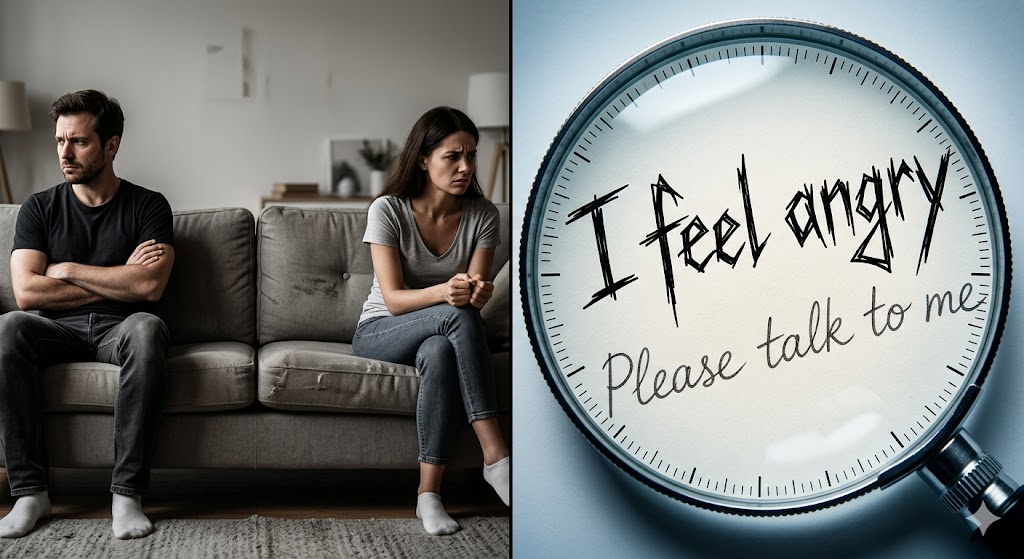
Why “Compatibility Quizzes” are Sabotaging You?
If you are researching the mechanics of relationship compatibility in 2026, you are likely in one of two distinct camps: you are either vetting a new partner before committing your life and capital, or you are desperately trying to salvage a failing marriage by understanding an insurmountable communication gap.
Your search intent is driven by a need for high-stakes risk mitigation.
Contrastive Analysis: The Demise of Astrology and Online Assessments
To understand the explosive demand for biometric compatibility audits, we must first destroy the amateur advice currently flooding the relationship counseling industry.
Myth 1: Love Languages and Online Quizzes Reveal the Truth.
The internet is saturated with self-reported personality tests. The fatal flaw? They rely entirely on conscious self-awareness and honesty. A highly narcissistic partner will simply fill out a quiz to appear empathetic and supportive. These tests measure self-delusion, not reality.
Myth 2: Opposites Attract vs. Birds of a Feather.
Generic relationship advice vacillates wildly between these two clichés. Neither is clinically accurate. Complete similarity in a relationship often breeds toxic stagnation, while complete opposition guarantees a war of attrition. True compatibility requires complementary friction—a balance that can only be mapped biometrically.
The Biometric Advantage:
In my experience analyzing thousands of couples at www.thegraphology.com, talk therapy often hits a wall because partners spend hours verbalizing their defenses. Graphology requires zero talking. It is the ultimate lie detector for the heart. We look at the ink, map the neuro-motor output, and instantly identify exactly where your emotional thermostats will clash.
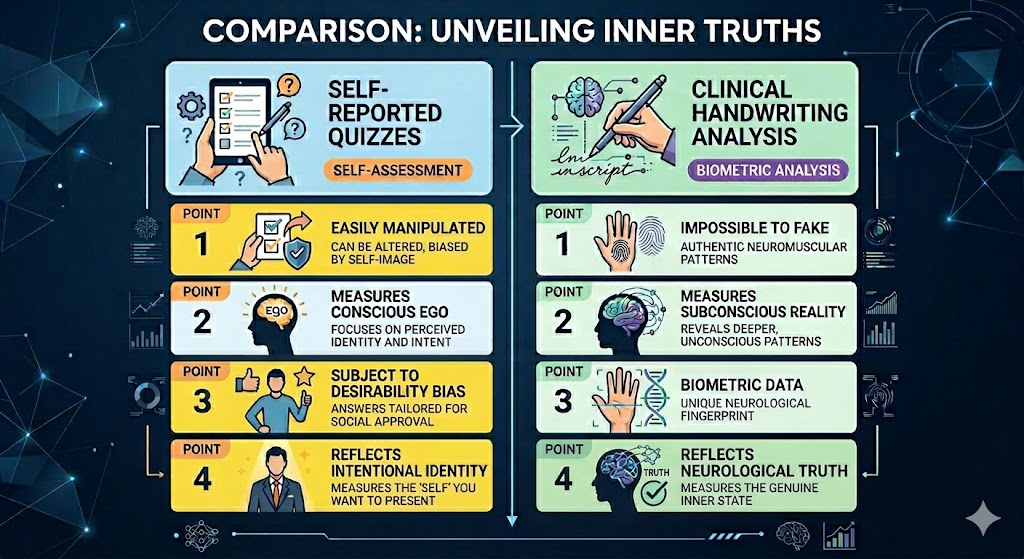
High Information Gain: The Architecture of a Relationship Audit
To properly execute a handwriting analysis for compatibility, we do not look for “identical” handwriting. If both partners have massive, heavily pressured rightward slants, the relationship will burn out in a fiery explosion of unchecked, competitive emotion.
We are looking for complementary zones, balanced emotional thermostats, and the absolute absence of deal-breaking red flags. Here is how we map the friction.
1. The Slant: The Emotional Thermostat
The angle at which the letters lean dictates how a person processes and expresses emotion. It is the core of romantic communication.
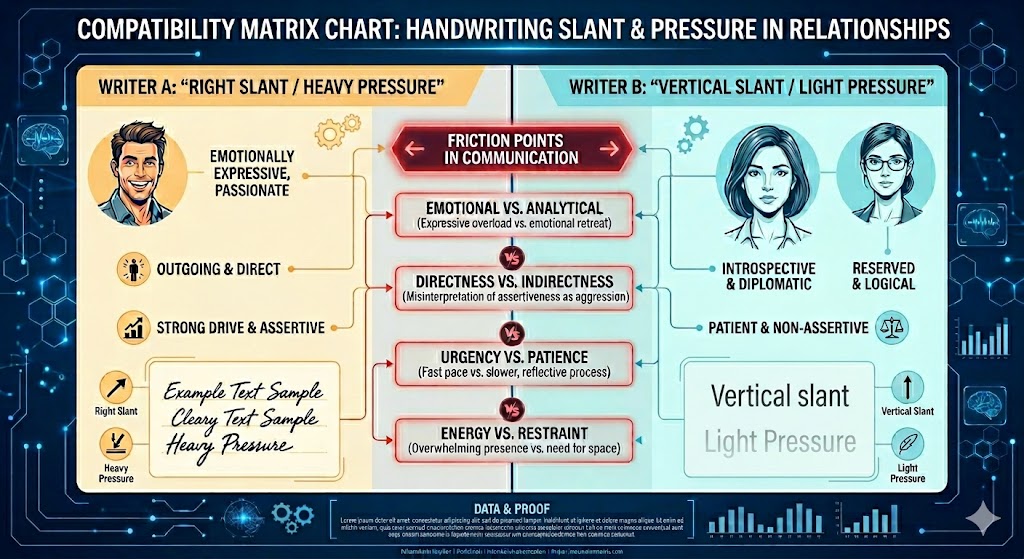
The Right Slant (The Expressive):
Writing that leans toward the right margin indicates a heart-led, empathetic, and highly expressive individual. They process the world through emotion and require constant, visible affection.
The Vertical Slant (The Pragmatist):
Writing that stands straight up indicates a head-led, logical individual. Their emotions are kept strictly in check by their intellect. They show love through acts of service and loyalty, not grand, weeping declarations.
The Compatibility Matrix:
A Right Slant pairing with a Vertical Slant is highly complementary. The Expressive brings warmth, while the Pragmatist brings grounding logic. However, if the Expressive does not understand graphology, they will constantly accuse the Pragmatist of being “cold” or “unloving,” simply because the Pragmatist’s central nervous system does not violently react to emotion.
2. Spatial Margins and Word Spacing: The Need for Boundaries
How a person treats the blank space on the page perfectly mirrors how they treat physical and emotional space in a relationship.
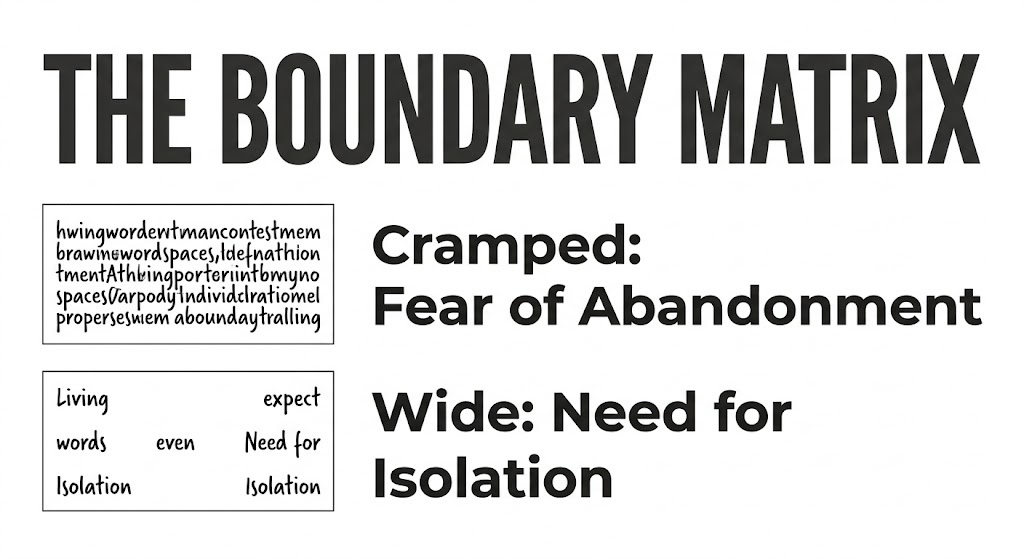
Cramped Word Spacing:
Words that are tangled tightly together reveal a partner who requires constant, suffocating closeness. They fear abandonment and lack emotional boundaries.
Wide Word Spacing:
Massive gaps between words indicate a fierce need for independence and isolation. They require massive amounts of “alone time” to recharge their neurological battery.
The Compatibility Matrix:
If a “Cramped Spacer” marries a “Wide Spacer,” the relationship is on a collision course. The Cramped partner will constantly feel rejected, while the Wide partner will constantly feel suffocated. Identifying this biometric reality allows couples to depersonalize their partner’s need for space.
3. Pen Pressure: The Libido and Vitality Metric
Pressure measures the depth of emotional intensity, physical energy, and libido.
Heavy Pressure:
Deep, embossing pressure reveals a partner with intense physical energy, a high sex drive, and deeply felt passions. However, they hold onto grudges tightly. Forgive and forget is not in their neurological vocabulary.
Light Pressure:
Light, airy pressure reveals a highly adaptable, intellectually driven partner. They avoid physical friction, let go of past arguments easily, but may possess lower physical stamina.
The Compatibility Matrix:
A severe mismatch in pen pressure often leads to a dead bedroom or a catastrophic imbalance in dispute resolution. The heavy-pressure writer will want to physically argue it out, while the light-pressure writer will attempt to logically detach and walk away.
First-Hand Experience: Synthesized Case Studies in Compatibility
Theory is meaningless without real-world application. Here are three synthesized case studies from our proprietary archives that demonstrate the raw, undeniable power of mapping relationship dynamics through ink.
Case Study 1:
The “Cold” Husband and the “Needy” Wife
A couple on the brink of divorce came to us for a final audit. The wife, an artist, was devastated because she felt her husband, a senior engineer, was completely emotionally detached.
She claimed he never validated her feelings and treated their marriage like a business transaction. He was exhausted, claiming she was a bottomless pit of emotional demands.
We analyzed their spontaneous writing samples. The wife’s writing featured a severe rightward slant, heavy pressure, and massive, sweeping lower loops. She was neurologically wired to feel everything at 100 miles per hour.
The husband’s writing was a masterclass in emotional compartmentalization. It was perfectly vertical, written in disconnected print, with extremely light pressure and wide word spacing.
The Verdict:
We laid the samples side-by-side on the table. We explained to the wife that her husband was not “withholding” love to punish her; his central nervous system simply processed the world entirely through logic. His disconnected print proved he needed time to process emotions sequentially, while her connected cursive meant she processed them simultaneously.
By taking the ego and the blame out of the equation and showing them the hard biometric data, the resentment evaporated. They weren’t fighting each other; they were fighting their conflicting neuro-motor wiring. We gave them actionable communication protocols based on their specific graphological profiles, and the marriage was saved.
Case Study 2:
Unmasking the Covert Narcissist
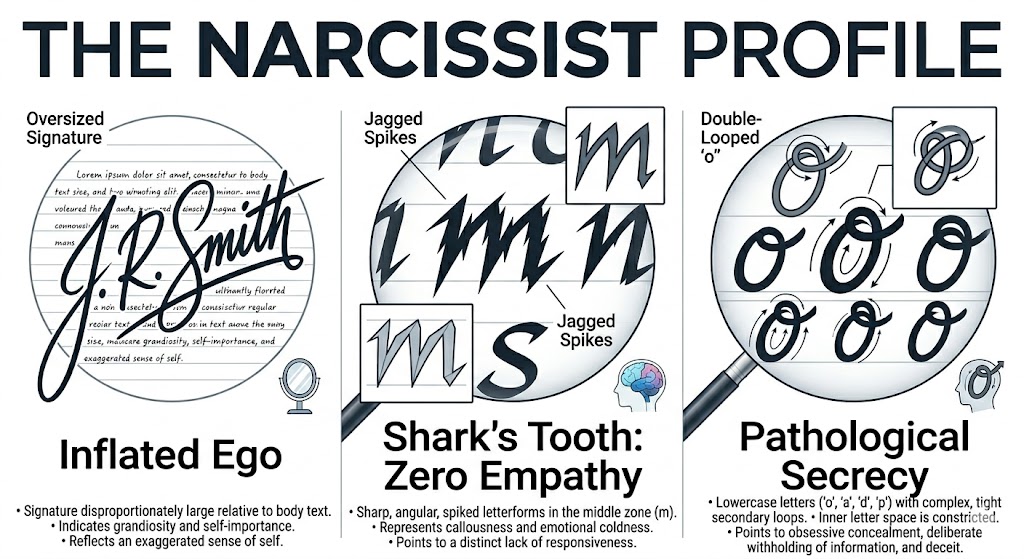
A highly successful female founder submitted her new fiancé’s handwriting for a baseline compatibility check before signing a prenup. On the surface, he was the perfect partner—charismatic, attentive, and incredibly supportive of her career.
His handwriting told a terrifyingly different story. His signature was massive—five times larger than his standard script—indicating a colossal, inflated ego masking deep internal inadequacy.
More importantly, his middle-zone letters (a, o, e) were filled with sharp, needle-like points instead of soft curves (the “Shark’s Tooth” formation), and his lowercase ‘o’s were tightly double-looped.
The Verdict:
I had to deliver the brutal truth. The massive signature paired with the tiny script revealed a man obsessed with his public image but entirely hollow inside. The Shark’s Tooth indicated a ruthless lack of genuine empathy—he viewed relationships as tactical conquests.
The double-looped ‘o’s were the ultimate red flag for chronic, pathological secrecy. We warned her that his charm was a calculated manipulation.
She paused the wedding. Three months later, she discovered he had been hiding massive gambling debts and a secondary relationship. The ink saw the betrayal long before the private investigator did.
Case Study 3:
The Silent Saboteur (The Felon’s Claw)
A couple in their early thirties came in for a routine pre-marital audit. They were deeply in love, but the boyfriend had a history of suddenly ending previous relationships right when things got serious.
His handwriting sample featured a prominent “Felon’s Claw.” This is a highly specific stroke where the lower zone (the tail of a ‘g’ or ‘y’) drops down and then aggressively hooks backward like a claw, rather than looping smoothly up to the right.
The Verdict:
The Felon’s Claw is the graphological footprint of deep subconscious guilt and self-sabotage. Individuals with this stroke subconsciously believe they are bad people who do not deserve happiness. When a relationship becomes safe and loving, their brain panics.
They will subconsciously detonate the relationship—usually through uncharacteristic cruelty or cheating—to prove to themselves that they are, indeed, unworthy.
We did not just diagnose the timebomb; we defused it. We initiated a strict graphotherapy protocol, forcing the boyfriend to practice a smooth, forward-moving lower loop for 30 days. By physically rewiring the stroke, we began to dismantle the subconscious guilt loop. They are now happily married with two children.
The Red Flags:
Absolute Dealbreakers in the Ink
While complementary differences can be managed, there are certain pathological markers that indicate severe emotional danger. If you spot these in a partner’s spontaneous handwriting, proceed with extreme clinical caution.
1. The Strikethrough Signature
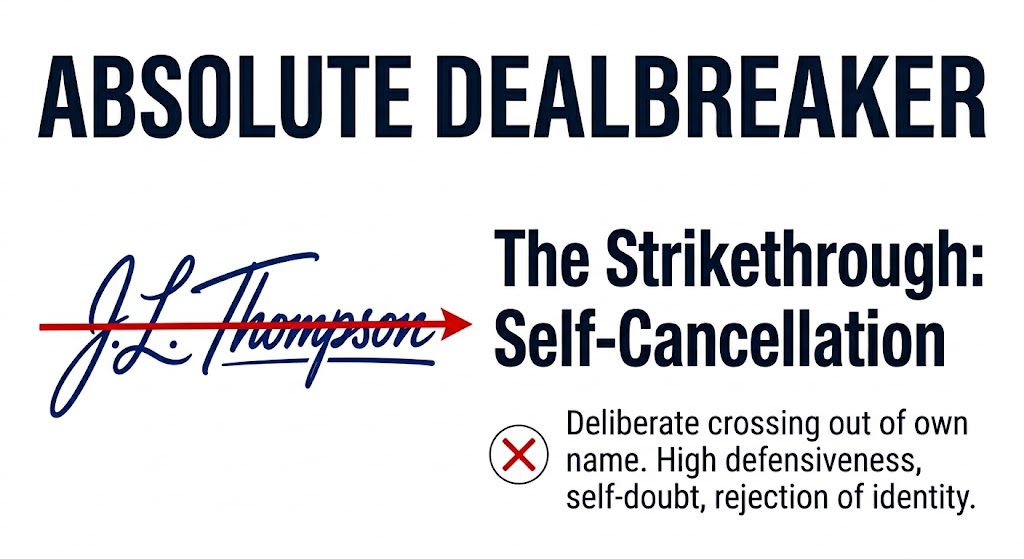
If a partner signs their name and draws a firm, horizontal line completely through it, run. This is the biometric equivalent of self-cancellation. They possess profound self-loathing and will inevitably sabotage their own success—and anyone attached to them.
2. Extreme Leftward Slant
A severe left slant in an adult’s handwriting is the ultimate psychological wall. It indicates a person who has experienced a massive past trauma or betrayal and has entirely shut down their emotional availability. They will never let you all the way in. You will spend your life trying to climb a fortress they have no intention of unlocking.
3. The “Stinger” Stroke
This occurs when the terminal stroke of a word in the middle zone shoots straight across to the right, resembling a bee’s stinger. It reveals a highly cynical, sarcastic personality. They cannot communicate openly; they will punish you with sharp, passive-aggressive remarks and weaponize your vulnerabilities during arguments.
4. Tangled, Illegible Middle Zones
If the lowercase letters (a, e, m, n) are completely illegible, tightly knotted, or look like a tangled thread, you are dealing with a partner who fundamentally refuses to be transparent. They are highly secretive, elusive, and will consistently gaslight you when pressed for the truth.
Executing a Joint Biometric Audit
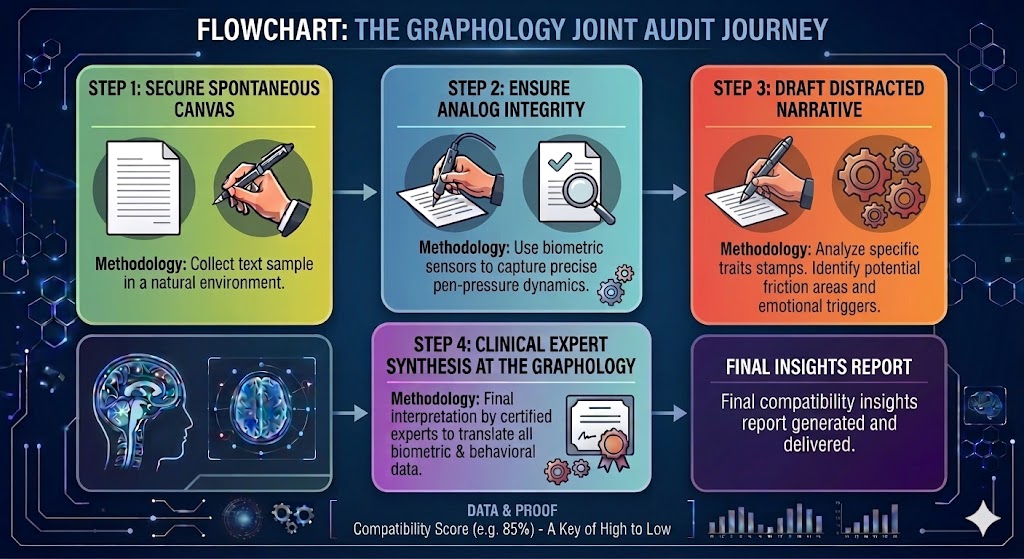
You cannot evaluate a relationship’s survival rate by analyzing a grocery list written on a moving train. To extract accurate, actionable data, you must follow strict clinical parameters. Here is the framework our experts at www.thegraphology.com utilize.
Step 1: Secure the Spontaneous Canvas
Pro-Tip: Both partners must provide a full-page, spontaneous handwriting sample on completely blank, unlined A4 or Letter-sized paper. Lined paper forces the brain to conform to a pre-set societal rule, masking the writer’s natural spatial boundaries and emotional baseline.
Step 2: Ensure Analog Integrity
Pro-Tip: The samples must be executed with a standard, medium-point ballpoint pen. Fountain pens, gel pens, and felt-tips absorb directly into the paper, completely destroying our ability to measure the physical tension and pen pressure (the libido and vitality metric).
Step 3: The Distracted Narrative
Pro-Tip: Do not copy text from a book or write dictated sentences. Copying utilizes a different part of the brain and invalidates the emotional baseline. Have both partners write a spontaneous page about a recent vacation, their career goals, or a neutral topic. The conscious mind must be focused on the narrative so the subconscious can transmit the neuro-motor data.
Step 4: The Dual Signature Inclusion
Pro-Tip: Both partners must sign the bottom of the page exactly as they would a legal document. We must measure the structural differential between their standard script (who they actually are in the living room) and their signature (the mask they wear in public) to determine their internal authenticity.
Graphotherapy for Couples:
Rewiring the Relationship
What happens if the analysis reveals significant friction? Are you doomed to break up?
Absolutely not. This is where clinical diagnosis transforms into high-level intervention. Graphotherapy is the clinical process of permanently altering core behavioral traits by rewiring the central nervous system through targeted handwriting exercises.
Because the brain dictates the micro-movements of the hand, the neuro-biological feedback loop is bi-directional. By consciously forcing your hand to repeatedly execute a specific, unfamiliar motor pattern—such as softening sharp angles to increase empathy, or elevating a baseline to cure pessimistic burnout—you send new kinetic and tactile data back to the brain.
If an audit reveals that one partner’s aggressive pen pressure and sharp angles are suffocating the other, we do not waste months in talk therapy discussing their anger.
We prescribe a 30-day graphotherapy protocol. We transition them to a smoother pen and introduce soft, flowing “garland” connections. The physical friction of practising the softer strokes forces their central nervous system to adopt a calmer, more empathetic baseline.
You physically rewrite the relationship’s communication code.
Why Elite Couples Trust www.thegraphology.com
The internet is saturated with generic relationship quizzes and automated AI handwriting apps that spit out automated horoscopes. Relying on an algorithm to make a decision about your marriage, your pre-nuptial agreement, or your family’s future is incredibly reckless.
An algorithm measures basic geometry. It cannot measure friction. It cannot synthesize the profound psychological contradiction of a massive, aggressive signature written with terrifyingly weak, erratic pen pressure.
At www.thegraphology.com, directed by Vikas Arora, we operate at the absolute bleeding edge of biometric psychological assessment. Every single joint compatibility audit is manually measured, contextualized, and evaluated by highly trained clinical experts. We map the exact friction in your subconscious, identify the blind spots that are actively sabotaging your love life, and hand you the definitive, neuroplastic tools to permanently fix them.
You spend thousands of dollars on dates, weddings, and couples therapy. It is time to audit the actual root code of your relationship. Stop guessing about your compatibility. Let us read the ink, and rewrite your reality.
Frequently Asked Questions
How accurate is handwriting analysis for compatibility compared to traditional counseling?
They serve completely different, yet highly complementary, purposes. Couples counseling relies entirely on verbal communication, which is filtered through ego, defensiveness, and a desire to “win” the argument.
Clinical graphology completely bypasses the ego. It provides a 100% objective, biometric baseline of why the couple is arguing in the first place, drastically accelerating the effectiveness of any subsequent therapy.
Can graphology determine if my partner is going to cheat on me?
Handwriting cannot predict a specific future action like infidelity. However, it vividly highlights the exact psychological traits that almost always lead to cheating.
A profile combining extreme emotional volatility (erratic baselines), a massive need for external validation (inflated signature), and highly secretive traits (double-looped ‘o’s) creates a dangerous neuro-motor blueprint of someone who lacks the boundaries to remain faithful under stress.
What if our handwriting styles are completely different? Are we incompatible?
Not necessarily. In fact, complete similarity can cause severe stagnation in a relationship. If both partners have extreme right slants and heavy pressure, the relationship may burn out in a fiery explosion of unchecked emotion.
Healthy, lasting relationships often require complementary differences—one grounding logical force paired with one driving emotional force. The key is ensuring neither partner possesses severe toxic markers.
Does print vs. cursive writing affect our romantic compatibility reading?
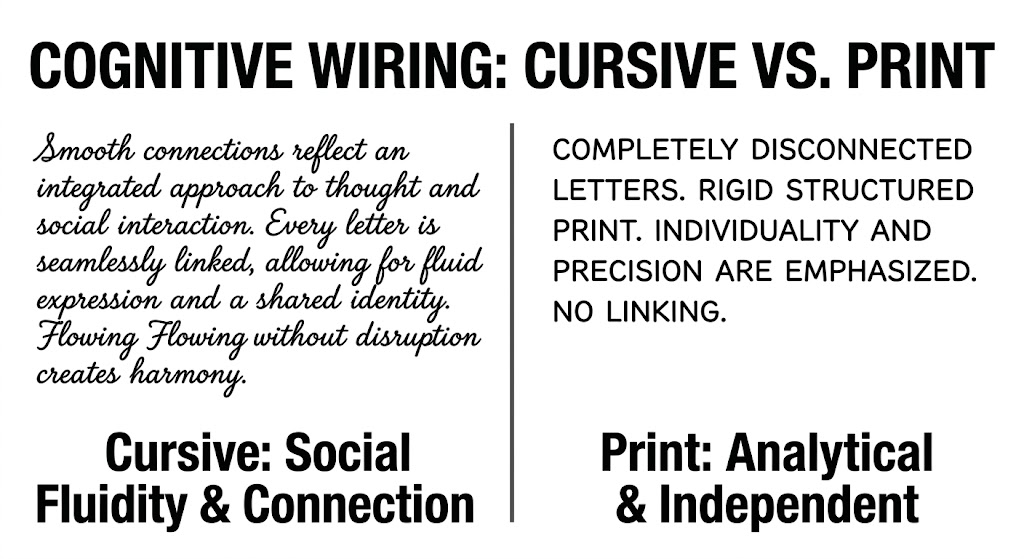
Yes, profoundly. A partner who writes entirely in connected cursive is naturally geared toward social fluidity, deep connection, and merging their life with others. A partner who writes entirely in disconnected print is fiercely independent, highly analytical, and requires massive amounts of personal space.
If a Cursive marries a Print, they must understand that the Print writer’s need for alone time is neurological, not a rejection of love.
How do I get my partner’s handwriting sample without raising suspicion?
The most clinically accurate samples are entirely spontaneous. Ask them to write down a recipe, draft a quick thank-you note to a relative, or write out a brainstorming list for an upcoming vacation. Ensure they write on blank, unlined paper with a standard ballpoint pen.
Do not hover over them while they write, as this induces anxiety and artificially alters their natural baseline.
Can a toxic trait in my own handwriting be fixed if I want to be a better partner?
Absolutely. This is the exact science of Graphotherapy. By isolating the destructive stroke—for example, softening the sharp, aggressive “Shark’s Tooth” angles into flowing curves—and practicing the new movement daily for 30 days, you feed new tactile data back to your brain.
This neuroplastic process slowly rewires the underlying emotional trigger, making you a more empathetic and secure partner.
Can analyzing two handwriting samples determine business partner compatibility?
Yes. Co-founder conflict is one of the leading causes of corporate failure. A joint biometric audit on business partners maps their specific psychological friction points. We can determine if their cognitive styles complement each other (e.g., a fast-paced visionary paired with a pragmatic, detail-oriented executor) or if clashing, inflated egos and secretive markers will eventually destroy the company from the inside out.
How long does it take to complete a joint compatibility audit?
Because we absolutely refuse to use automated AI algorithms and mandate that every single joint audit is manually synthesized, mapped, and evaluated by human clinical experts, the standard turnaround time for a comprehensive compatibility profile at www.thegraphology.com is typically 5 to 7 business days from the moment the verified samples are submitted to our team.
Is a biometric handwriting audit useful for arranged marriages or early-stage dating?
It is arguably the ultimate due diligence tool for high-stakes matchmaking. When families or individuals are merging lives without decades of prior history, a clinical audit bypasses the polite dating facade.
It instantly reveals if a prospective partner possesses the emotional maturity, transparency, and psychological stability required for a lifelong commitment, potentially saving you years of emotional and financial heartache.
Can handwriting analysis reveal if my partner is financially responsible or a reckless spender?
Absolutely. Financial anxieties and material drives are rooted in the “lower zone” of handwriting (the descending loops of letters like ‘g’, ‘y’, and ‘j’). Extremely inflated, tangled, or erratic lower loops indicate a dangerous impulsivity with money and a constant subconscious craving for material validation. Conversely, perfectly structured, moderate loops suggest grounded financial discipline and aligned long-term planning.
Are there specific strokes that warn of hidden anger issues or emotional abuse?
Yes. We specifically look for the “Shark’s Tooth” formation—middle-zone letters (like ‘m’ or ‘n’) that resemble sharp, jagged spikes rather than soft, flowing curves. When this is combined with heavy, rigid pen pressure and a severe rightward slant, it creates a neuro-motor profile of a highly reactive, cynical partner who views relationships as a tactical battlefield and lacks fundamental empathy during arguments.
My handwriting is messy, but my partner’s is perfectly neat. Will this cause relationship friction?
“Messy” versus “neat” is an aesthetic judgment, not a clinical one, but the psychological friction is very real. A partner with perfectly rigid, flawless script is often a highly structured perfectionist who fears losing control.
A partner with fast, illegible handwriting is typically an impatient, abstract thinker. Without a clinical audit to explain these cognitive differences, the perfectionist will feel overwhelmed by chaos, and the fast-thinker will feel constantly micromanaged.
Can a compatibility analysis predict if we are going to get a divorce?
Clinical graphology does not predict the future; it diagnoses the present. We cannot guarantee a divorce, but we can definitively identify the exact communication breakdowns—such as extreme defensiveness, deep-seated resentment, or profound emotional detachment—that statistically lead to relationship failure if left untreated. We map the friction so you can intervene and fix it before the breaking point.
What if my partner suspects they are being analyzed and tries to disguise their handwriting?
It is biologically impossible to maintain a disguised script for more than a few lines. Writing is a deeply ingrained neuromuscular habit. While a partner might consciously try to write “nicer” or change their slant initially, cognitive load takes over as they focus on the actual content of the narrative.
By the middle of the page, their natural, subconscious neuro-motor patterns will inevitably bleed through to the paper.
Does it matter if my partner is left-handed when checking our compatibility?
Not at all. This is one of the most persistent myths in the industry. Clinical graphology measures the neurological output of the brain, not the mechanical limitations of the hand. Whether a person is right-handed, left-handed, or ambidextrous, their central nervous system dictates the spatial arrangement, baseline trajectory, and stroke tension in the exact same measurable way. The compatibility metrics remain 100% identical.
We have been married for a decade. Will a joint handwriting audit still benefit us?
Profoundly. People evolve, and so do their neuro-motor blueprints. The defense mechanisms you relied on in your twenties are likely causing unnecessary friction in your thirties or forties. A joint audit for a long-term marriage acts as a critical psychological recalibration.
It uncovers silent resentments (like a descending baseline indicating chronic burnout) and provides targeted graphotherapy to refresh and realign your emotional connection.