Executive Summary:
A Personal Handwriting Report is a comprehensive, biometric psychological profile generated from an individual’s spontaneous handwriting.
By clinically analyzing micro-movements like pen pressure, baseline trajectory, and slant, certified graphologists decode your subconscious emotional intelligence, uncover hidden defense mechanisms, and provide an exact blueprint for permanent personal development.
The Hamster Wheel of Self-Discovery
We are living in an era of unprecedented, yet entirely superficial, self-awareness.
If you are like most high-achievers, you have likely spent hundreds of hours—and potentially thousands of dollars—trying to “find yourself.” You have taken the Myers-Briggs assessment, memorized your Enneagram number, and filled out countless online personality quizzes.
You read the results, feel a momentary rush of validation, and then… nothing changes. You still suffer from the same imposter syndrome before a big presentation. You still attract the same toxic romantic partners. You still hit the same invisible financial ceilings.
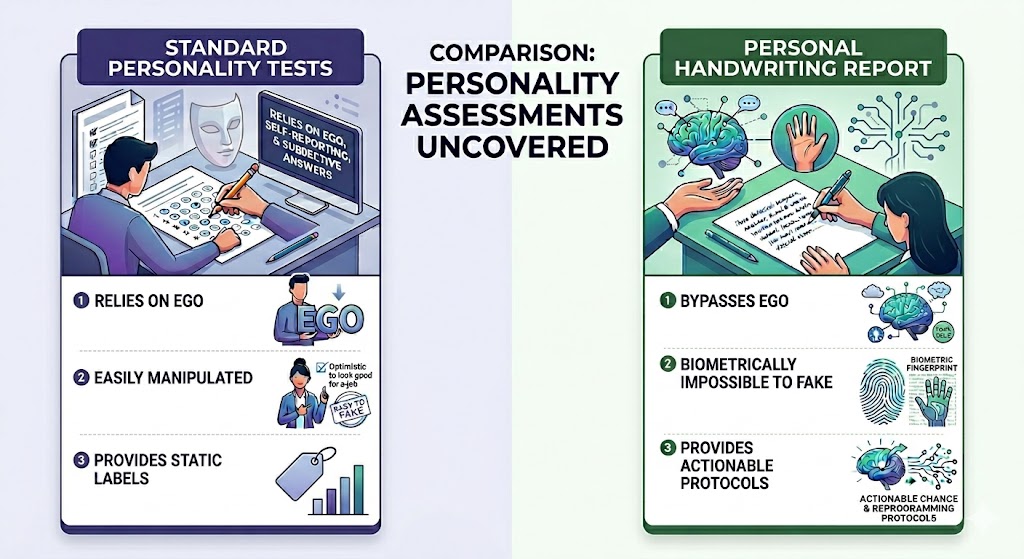
Why? Because the entire modern self-help industry is built on a fundamental psychological flaw: Self-Reporting Bias. When you take an online quiz, your ego is holding the mouse. You answer questions based on who you wish you were, not who your central nervous system actually dictates you are.
You are actively filtering your reality. But what if there was a diagnostic tool that completely bypassed your conscious ego? A tool that mapped the raw, unfiltered neuro-motor data of your brain?
There is. If you are finally ready to stop negotiating with your ego and uncover the biometric truth of who you are, you need a Personal Handwriting Report.
At www.thegraphology.com, we do not ask you to fill out multiple-choice questions. We look at the physical friction, the spatial arrangement, and the trajectory of your ink to hand you the ultimate operating manual for your mind.
Why You Are Actually Here?
If you are researching this topic, you have moved past casual curiosity. Your search intent is diagnostic. You are experiencing friction in your life—whether in your career trajectory, your marriage, or your internal mental health—and you are actively investigating a high-ROI solution to audit your subconscious. You want empirical data, not horoscopes. You are seeking a clinical intervention.
Why Standard Assessments are Failing You in 2026?
To understand the explosive demand for clinical graphology, we must dismantle the outdated psychological frameworks that are currently keeping you stuck.
The Failure of the Algorithm:
The internet is flooded with five-dollar “AI handwriting scanners.” These algorithms measure basic geometry, but they completely fail at synthesis.
If an AI detects heavy, aggressive pen pressure but a terrified, retreating leftward slant, it spits out a contradictory error. It cannot understand the human nuance of a person who is full of rage but terrified of expressing it. A true clinical report requires human oversight.
The “Fixed Personality” Myth:
Standard psychology often treats personality as a static trait locked in by age 25. Clinical graphology relies on the scientifically proven concept of neuroplasticity. Your handwriting—and therefore your personality—is a real-time, adaptable output. We don’t just tell you who you are; we map exactly how to change it.
The “I/We” Perspective:
In my experience analyzing thousands of biometric profiles, the most profound breakthroughs occur when a client reads their report and says, “I have never told anyone this about myself.” Our data shows that a clinical audit of your ink reveals defence mechanisms that even years of traditional talk therapy often fail to uncover, simply because graphology requires zero verbal rationalization.
The Anatomy of a Personal Handwriting Report
What exactly are you paying for when you commission a clinical profile? You are not paying for someone to tell you if your handwriting is “pretty.” Aesthetics are irrelevant. You are paying for a comprehensive mapping of your central nervous system.
Here is the exact architectural breakdown of the data we extract during your audit.
Module 1: The Emotional Thermostat (Slant and Spacing)
The angle of your letters and the space between your words dictate how you process and express emotion.
The Slant Matrix:
Do you write with a severe rightward slant? Your report will detail your high empathy, your impulsivity, and your profound need for external validation. Do you write with a strict vertical slant? We will map your intense logical compartmentalization and your tendency to emotionally detach during conflicts.
The Trauma Wall (Left Slant):
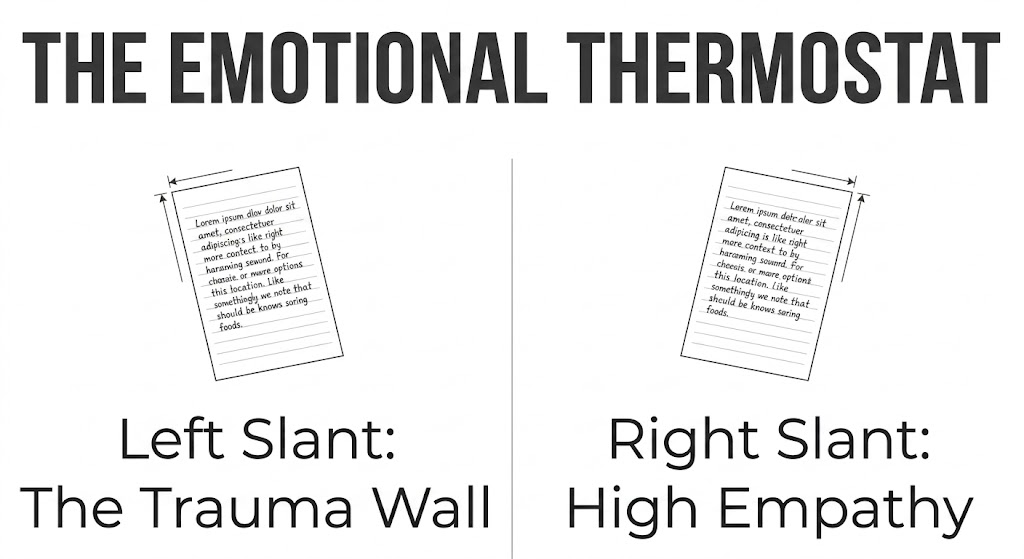
If your writing pulls backwards toward the left margin, your report will gently but clinically address your core defense mechanism. We will map the deep-seated fear of vulnerability—often rooted in a past betrayal—that is actively preventing you from forming authentic connections.
Spatial Boundaries:
We measure the exact millimeter gaps between your words to determine your neurological need for personal space. We will tell you exactly why you feel suffocated in crowded environments or why you suffer from chronic codependency.
Module 2: The Vitality and Resilience Engine (Pressure and Baseline)
The Baseline Trajectory:
The invisible line your words rest upon is your emotional heartbeat. If your baseline is consistently ascending, your report will highlight your relentless optimism and executive drive. If your lines droop downward, we will flag a critical state of physiological burnout and silent depression, warning you of impending emotional exhaustion.
Pen Pressure Dynamics:
Pressure measures friction. Heavy, embossing pressure reveals a client with massive physical vitality, intense passion, but a dangerous tendency to hold onto grudges and resentment. Light, airy pressure reveals a highly adaptable, intellectual thinker who avoids conflict but may lack the stamina for long-term endurance tasks.
Module 3: The Ambition and Execution Blueprint (Zonal Proportions)
We divide your handwriting into three spatial zones to map your Id, Ego, and Superego.
[H4] The Upper Zone (Intellect & Vision):
Massive upper loops (like in ‘l’ or ‘h’) reveal a philosophical, visionary thinker. But if the lower loops are stunted, your report will diagnose “Visionary Paralysis”—you have brilliant ideas but absolutely zero execution skills.
The T-Bar Indicator:
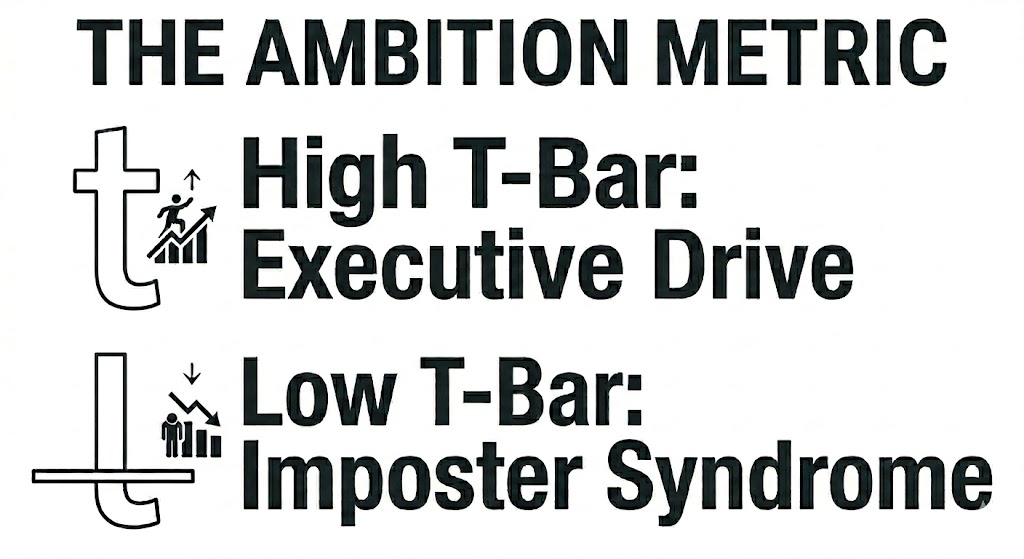
This is the most critical metric for career development. We analyze the horizontal cross on your lowercase ‘t’. A high, firm crossbar indicates massive self-esteem and goal-setting capacity. A low crossbar is the undeniable biometric footprint of imposter syndrome. Your report will tell you exactly how this low t-bar is costing you money in salary negotiations.
The Lower Zone (Biological Drives):
The tails of your ‘y’s and ‘g’s map your relationship with money, physical security, and sexuality. Tangled, erratic lower loops will trigger a warning in your report regarding financial impulsivity and a chaotic approach to material stability.
Module 4: The Persona Gap (Signature vs. Script Analysis)
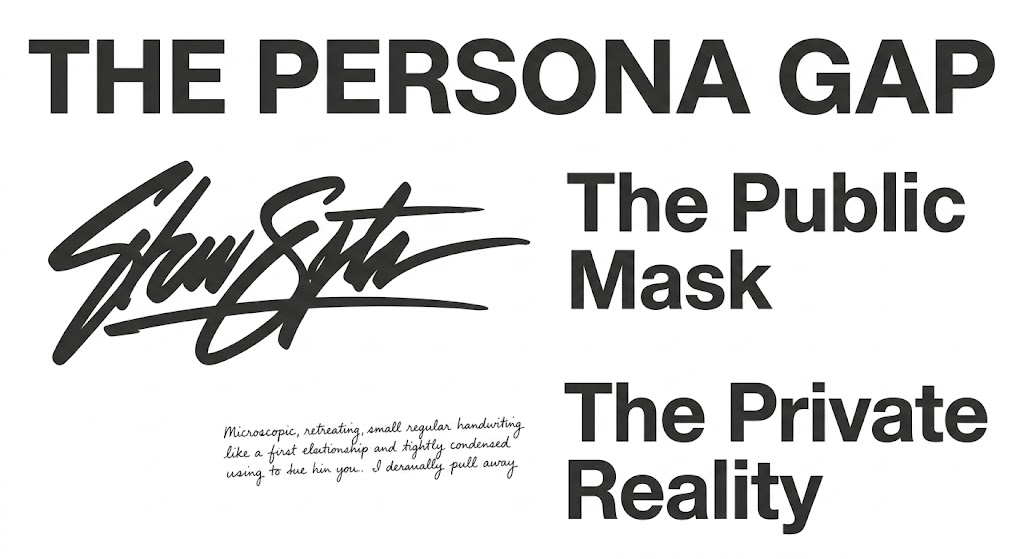
Your signature is the public mask you wear; your standard script is your private reality.
Measuring the Discrepancy:
Your report will include a dedicated analysis comparing these two outputs. If your signature is massive and bold, but your regular handwriting is microscopic and retreating, we will diagnose a severe “Persona Gap.”
You will receive a clinical breakdown of why you are overcompensating in public to hide a profound internal inferiority complex, and how this is draining your daily energy reserves.
First-Hand Experience: Synthesized Case Studies of Subconscious Audits
Theory is fascinating, but execution is what changes lives. To truly grasp the ROI of commissioning a biometric profile, consider these synthesized case studies from our clinical archives at www.thegraphology.com.
Case Study 1: The “Successful” Burnout
A highly compensated corporate attorney commissioned a report because he was experiencing terrifying bouts of insomnia and sudden panic attacks. His doctors prescribed medication, but the underlying dread remained. He thought he was losing his edge.
We processed his spontaneous handwriting sample. His script revealed perfectly constructed, sharp, and fast-paced letter formations—confirming his brilliant, analytical mind. However, two catastrophic red flags emerged. First, his baseline was descending at a severe 15-degree angle. Second, his middle-zone letters (a, e, o) were microscopic and completely squeezed together.
The Clinical Verdict:
His report delivered the hard truth. He was not losing his intellectual edge; he was in the final stages of total neurological burnout (the descending baseline). Furthermore, his microscopic middle zone revealed that despite his massive salary, his daily ego was completely crushed. He felt invisible and unappreciated by his firm.
The Aftermath:
Seeing his internal suffering objectively mapped out as biometric data provided immediate validation. He wasn’t “weak”; his central nervous system was simply out of battery. Armed with the report, he took a mandatory three-month sabbatical and utilized graphotherapy to rebuild his baseline. He returned to his firm, negotiated a boundary-driven contract, and eliminated the panic attacks.
Case Study 2: The Silent Saboteur (The Felon’s Claw)
A woman in her early thirties ordered a report because she could not understand why her romantic relationships always detonated at the one-year mark. She blamed her partners, claiming she just had “bad luck with toxic men.”
Her handwriting analysis revealed a completely different reality. Her script was riddled with the “Felon’s Claw.” This is a highly specific pathological stroke where the lower zone (the tail of a ‘y’ or ‘g’) drops down and aggressively hooks backwards like a claw, rather than sweeping smoothly up to the right.
The Clinical Verdict:
Her report explicitly detailed the nature of the Felon’s Claw: it is the graphological footprint of deep subconscious guilt and intentional self-sabotage. Individuals with this stroke subconsciously believe they do not deserve happiness. When a relationship becomes safe, their brain panics, and they subconsciously detonate it to prove their own unworthiness.
The Aftermath:
The report shattered her victim mentality. For the first time, she realized she was the common denominator in her failed relationships. We provided a strict 30-day graphotherapy protocol to physically rewire the claw into a healthy, forward-moving loop. By altering the neuro-motor pathway, she eradicated the subconscious guilt. She is now happily engaged.
How to Secure Your Clinical Report
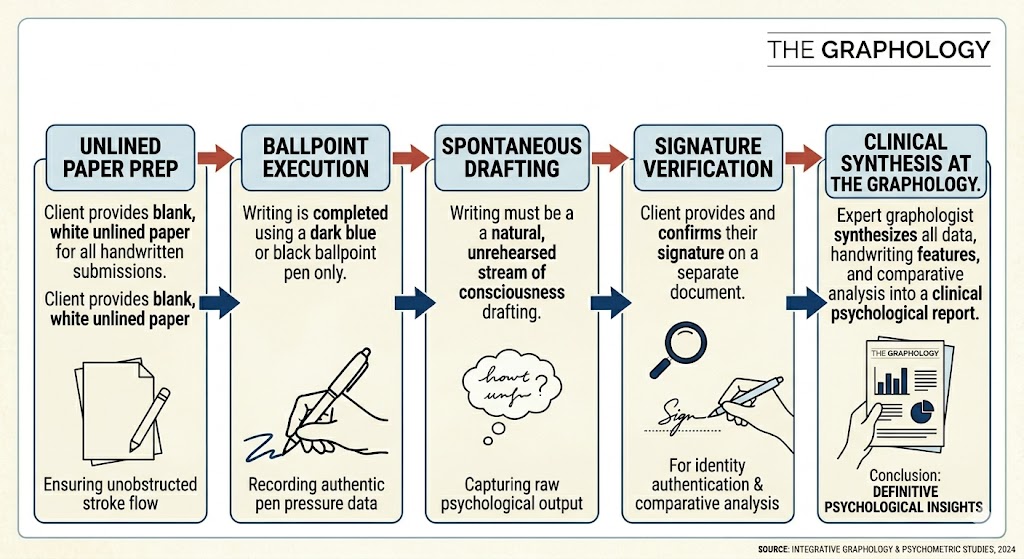
You cannot extract a highly accurate psychological blueprint from a digital signature on a PDF or a grocery list written in pencil. To generate a flawless report, you must follow strict clinical parameters. Here is the exact submission framework our experts require.
Step 1: The Unlined Canvas Protocol
To extract your true neurological output, we must remove all artificial boundaries.
- Pro-Tip: You must provide a full-page, spontaneous handwriting sample on completely blank, unlined A4 or Letter-sized paper. Lined paper forces your brain to conform to a pre-set societal rule, completely masking your natural spatial organization and emotional baseline.
Step 2: The Analog Mandate (Ballpoint Only)
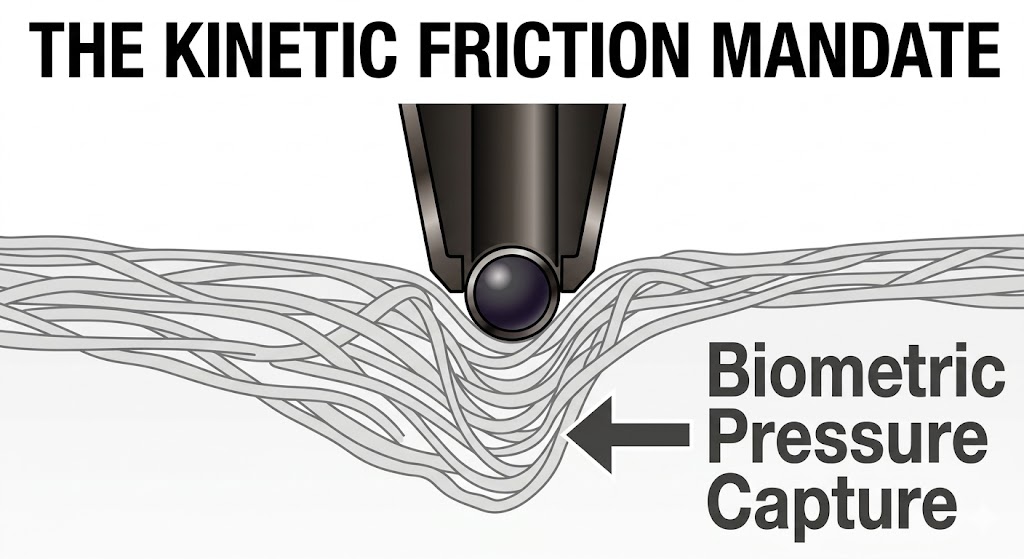
The physical tool dictates the quality of the biometric data.
- Pro-Tip: The sample must be written with a standard, medium-point ballpoint pen. Fountain pens, gel rollers, and felt-tip markers absorb effortlessly into the paper. This completely destroys our ability to measure pen pressure, which is the vital metric for assessing your energy levels, libido, and internal anger.
Step 3: The Distracted Narrative
The conscious ego must be distracted so the subconscious can take over the pen.
- Pro-Tip: Do not copy text from a book or write dictated sentences. Copying utilizes a completely different part of the motor cortex and invalidates the emotional baseline. Write about a recent business challenge, a frustrating argument, or your long-term goals. Let your mind wander into the content so your hand can operate on autopilot.
Step 4: The Dual Signature Verification
We must measure the gap between your public mask and your private reality.
- Pro-Tip: Always sign the bottom of the page exactly as you would a legal contract. We will calculate the structural differential between your standard script and your signature to determine your level of internal authenticity.
Step 5: Clinical Expert Synthesis
Once submitted to www.thegraphology.com, your sample enters our lab.
- Pro-Tip: We refuse to use automated AI. A certified clinical graphologist will manually measure, contextualize, and evaluate over 100 distinct micro-movements in your ink. Within 5 to 7 business days, your comprehensive, multi-page psychological blueprint is delivered directly to your inbox.
The Next Step: Graphotherapy and Subconscious Rewiring
A world-class Personal Handwriting Report does not just diagnose your flaws and leave you stranded. It provides the cure.
Every comprehensive report generated by our clinic includes targeted Graphotherapy recommendations. If the analysis reveals that your low t-bars are causing severe imposter syndrome, your report will include a specific, physical handwriting exercise designed to counteract it.
Because your brain dictates the micro-movements of your hand, the biological feedback loop is bi-directional. By consciously forcing your hand to repeatedly execute a specific, unfamiliar motor pattern—like crossing your t-bar higher to build confidence—you send new kinetic and tactile data back to your central nervous system.
Practicing these targeted strokes for 15 minutes a day, over a strict 30-day period, relies on the scientifically proven principles of neuroplasticity. You literally build new neural pathways. By the end of the protocol, the new handwriting trait becomes autonomic muscle memory, and the corresponding psychological shift becomes a permanent part of your personality.
We don’t just read your mind; we give you the pen to rewrite it.
Why Elite Performers Choose www.thegraphology.com
The internet is saturated with generic quizzes, astrology charts, and novelty AI handwriting apps that spit out contradictory horoscopes. If you are a junior employee looking for five minutes of entertainment, those apps are perfectly fine.
But if you are a high-achiever managing a massive career, navigating a complex marriage, or trying to break a cycle of generational trauma, relying on an algorithm to diagnose your subconscious is incredibly reckless.
At www.thegraphology.com, under the direction of Vikas Arora, we operate at the absolute bleeding edge of biometric psychological assessment. We map the friction in your subconscious, identify the blind spots your friends and colleagues are afraid to tell you about, and hand you the exact neurological tools to fix them.
You spend thousands of hours optimizing your diet, your investment portfolio, and your digital footprint. It is time to optimize the root code of the human operating all of them. Stop guessing about who you are. Let us read the ink.
Frequently Asked Questions
How accurate is a personal handwriting report compared to standard psychology tests?
It is vastly superior in terms of objectivity. Standard tests (like MBTI or Enneagram) rely on self-reporting; you answer based on your conscious biases and how you wish to be perceived. Graphology bypasses the ego entirely. It measures involuntary neuro-motor outputs, providing a 100% objective, biometric baseline of your emotional intelligence, defense mechanisms, and cognitive processing.
Will my report reveal my specific career path or future destiny?
Graphology is not fortune-telling; it cannot predict if you will become a doctor or win the lottery. However, it accurately maps the behavioural traits that lead to success in specific environments. Your report will definitively identify if you possess the relentless ambition, strategic logic, and emotional resilience required to build a business, or if you are better suited for a highly structured, analytical corporate role.
Does my handwriting change over time, and will that invalidate my report?
Your handwriting must change because your neurological state changes. While your core writing mechanics remain relatively stable, your script fluctuates based on immediate physical fatigue, emotional trauma, or personal growth. Your report captures a hyper-accurate, biometric snapshot of your exact psychological state at the moment the sample was written, making it the ultimate real-time diagnostic tool.
What happens if I have “messy” or completely unreadable handwriting?
Clinical graphology does not judge aesthetics. “Messy” handwriting often belongs to highly intelligent, fast-paced thinkers whose cognitive processing speed simply outpaces their hand’s mechanical ability.
We do not evaluate neatness; we evaluate friction. However, if your handwriting is deliberately illegible (especially in the middle zone), your report will flag this as a subconscious defense mechanism, indicating extreme secrecy and a desire to evade accountability.
Can my report diagnose severe mental illnesses like depression or bipolar disorder?
While certified graphologists frequently identify the intense neurological tremors associated with extreme anxiety, substance abuse, or the descending baselines of profound burnout (which mimics depressive fatigue), it is strictly unethical to use graphology to diagnose medical pathologies. Your report is a tool for behavioral and psychological mapping, not a replacement for psychiatric medical diagnosis.
Does it matter if I write in cursive or disconnected print for my sample?
Both styles are perfectly valid but reveal different primary operating systems. Cursive (connected) writing indicates a brain wired for social fluidity, empathy, and the seamless integration of ideas.
Print (disconnected) writing reveals a fiercely independent, highly analytical thinker who compartmentalizes their emotions and demands strict personal boundaries. Your report will detail exactly how your specific style impacts your relationships.
Can I practice the graphotherapy recommendations on an iPad or digital tablet?
For the initial 30-day neuroplastic rewiring phase prescribed in your report, you must strictly use physical paper and a ballpoint pen. Digital screens lack the necessary kinetic friction and pressure resistance required to trigger a deep neuro-motor response in the brain.
Once the muscle memory is permanently locked into your autonomic nervous system via analog practice, the psychological benefits will transfer everywhere.
How long does it take to receive my completed personal handwriting report?
Because we absolutely refuse to use automated AI algorithms and mandate that every single sample is manually synthesized, measured, and evaluated by human clinical experts, the standard turnaround time for a comprehensive, multi-page psychological profile at www.thegraphology.com is typically 5 to 7 business days from the moment your verified sample is submitted.
What exactly is included when I order a Personal Handwriting Report?
Your comprehensive Personal Handwriting Report is a multi-page clinical blueprint of your subconscious mind. It details your core defense mechanisms, emotional intelligence, stress triggers, and cognitive processing style.
Crucially, it concludes with a highly customized graphotherapy prescription—specific pen-strokes you must practice to permanently rewire any self-sabotaging traits our experts uncover.
Is my signature alone enough to generate a full psychological profile?
No. A signature only reveals your public mask—how you want the boardroom or the world to perceive you. To generate a highly accurate Personal Handwriting Report, our experts must analyze a half-page of your spontaneous standard script (your private reality) alongside your signature.
The most profound insights are extracted by measuring the exact biometric friction between who you pretend to be and who you actually are.
Does being left-handed alter the results of my analysis?
Not at all. This is a persistent amateur myth. Clinical graphology measures the neurological output of your central nervous system, not the mechanical limitations of your hand.
Whether you are left-handed, right-handed, or ambidextrous, your brain dictates the spatial arrangement, baseline trajectory, and stroke tension in the exact same measurable way.
Is the biometric data I submit for my report kept strictly confidential?
Absolutely. At www.thegraphology.com, we operate under strict clinical confidentiality and ironclad NDAs. The physical sample you submit, the biometric data extracted from your ink, and your finalized psychological blueprint are heavily protected. We never share, publish, or sell your private neuro-motor data to unauthorized third parties.
Can this report detect if someone is chronically dishonest or manipulative?
While graphology does not act as a polygraph for one specific lie, it vividly highlights the neurological markers of chronic deception.
Traits such as heavily retraced letters, double-looped ‘o’s (indicating extreme, paranoid secrecy), and a deliberately tangled middle zone collectively paint a profile of an individual who systematically avoids the truth. The ink cannot hide your core integrity.
How quickly will I experience changes if I follow the report’s rewiring exercises?
The neuroplastic protocol requires exactly 15 minutes of unbroken daily focus. You will likely feel significant psychological resistance (friction) during the first week as old, self-limiting neural pathways fight the change. However, by day 14 to 21, clients report profound shifts in their physical posture, vocal authority, and internal calmness as the new, confident stroke becomes autonomic muscle memory.
Can I order a profile for my spouse or business partner without them knowing?
We strongly advise against this. While you can technically submit a sample written by a partner, a true clinical intervention requires their conscious willingness to change.
If your goal is to resolve conflict or assess relationship viability, we highly recommend ordering a joint compatibility audit where both parties consciously submit their biometric data for a mutual, objective baseline.
Does the analysis still work if English is not my primary language?
Yes. Clinical graphology focuses on universal biometric outputs—such as margin spacing, pen pressure, baseline trajectory, and the kinetic tension of the stroke—not specific vocabulary or grammar.
Because human neurology is universal, our experts can accurately map your psychological operating system regardless of whether you write in the Latin, Cyrillic, Arabic, or Devanagari alphabet.