Executive Summary
Professional handwriting analysis is the biometric evaluation of neurological micro-movements captured on paper.
By meticulously measuring pen pressure, baseline trajectory, and spatial arrangement, certified experts decode an individual’s subconscious emotional intelligence, cognitive processing style, and hidden defense mechanisms.
This scientific approach provides an uneditable, deeply accurate psychological blueprint for personal and professional mastery.
The Illusion of Self-Awareness

Most people will go to their graves without ever truly meeting themselves.
You construct a heavily curated narrative of who you are. You memorize your personality type from free online quizzes, rehearse your strengths for job interviews, and build an impenetrable social mask to survive the daily friction of human interaction.
But there is a massive, silent chasm between who you consciously pretend to be and who your central nervous system dictates you are.
When you sit down, uncap a pen, and drag it across a blank sheet of paper, your conscious mind is entirely preoccupied with spelling, grammar, and the message itself. It forgets to maintain the mask.
Meanwhile, your brain’s motor cortex is actively transmitting your deepest fears, your raw ambition, and your unhealed trauma straight into your fingertips. You cannot fake the microscopic tension in your hand.
You are reading this because you have hit a wall. You are exhausted by repeating the same toxic relationship patterns, hitting the same financial ceilings, and dealing with a persistent, low-grade anxiety you cannot articulate.
You do not need another self-help book filled with empty platitudes. You need the unvarnished truth. Through the rigorous, clinical application of handwriting analysis, we bypass your ego entirely. We do not ask you to self-report your flaws; we read the neurological data your brain has already left on the page.
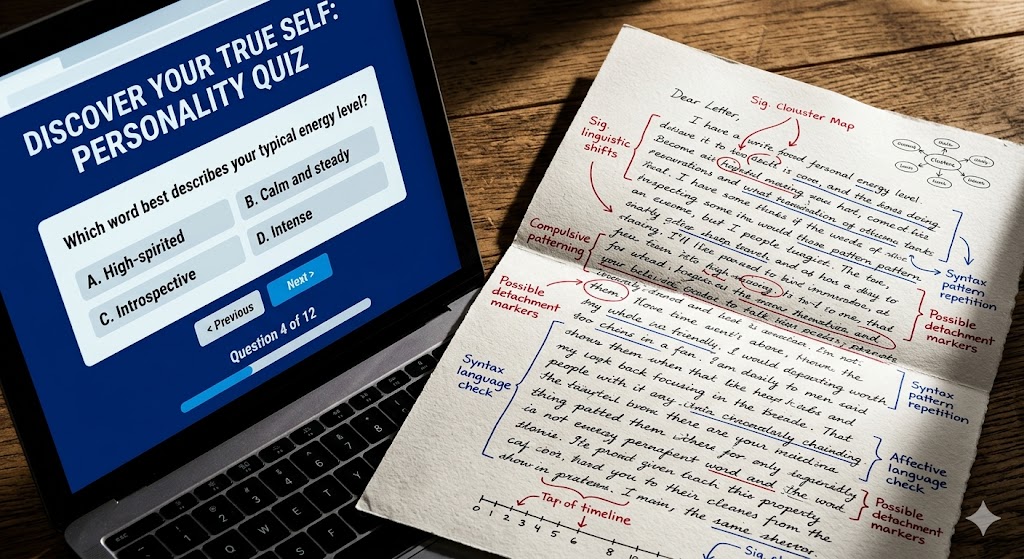
Why the World is Returning to Paper ?
The modern human is fundamentally distrustful of digital assessments, and for good reason. If you are searching for answers about your psychology, you are executing a commercial investigation into your own mind.
You want a diagnostic tool that is immune to manipulation, bias, and temporary moods. You are looking for root-cause diagnostics.
Contrastive Analysis: The Collapse of the “Self-Reported” Industry
The psychological assessment industry is currently worth billions, yet it is built on a fundamentally flawed premise: asking people to tell the truth about themselves. Let us dismantle the myths that are failing you in 2026.
Myth 1: Multiple-Choice Quizzes Reveal Your True Self.
If a test asks, “Do you handle stress well?” your ego immediately interferes. You remember that one time you stayed calm during a traffic jam, ignore the fifty times you panicked, and check “Yes.”
These tests measure your self-delusion, not your reality.
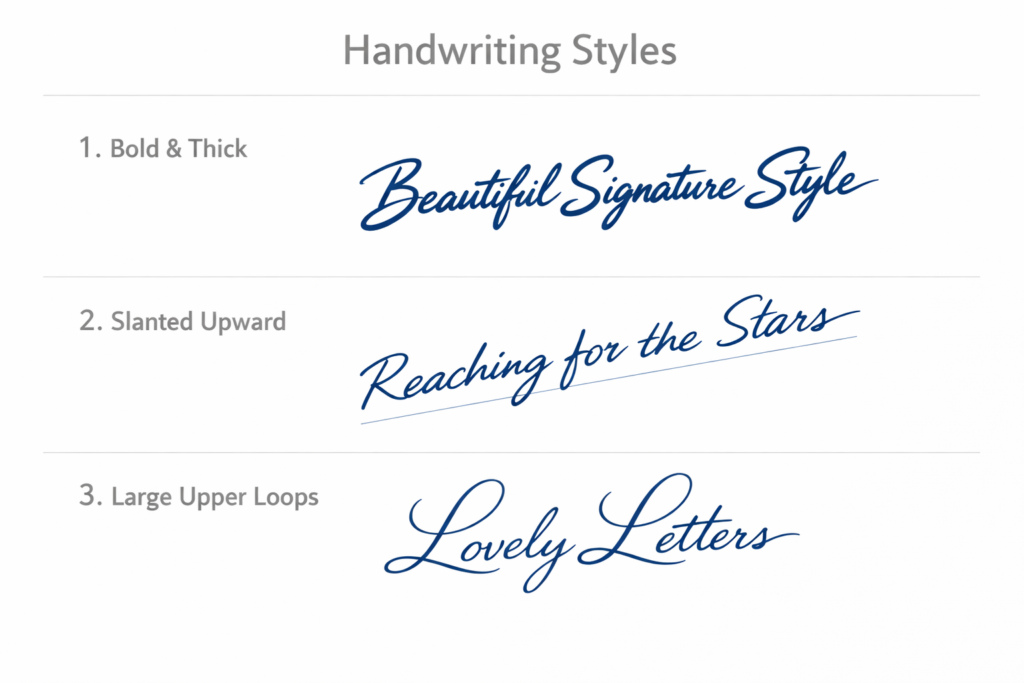
Myth 2: It Is Just About “Reading Pretty Letters.
Amateurs look at ink to see if it is “neat” or “pretty.” This is a dangerous oversimplification. A beautifully stylized, flawless script often indicates a personality rigid with anxiety, desperately trying to maintain a facade of perfection.
Clinical graphology does not care about aesthetics; it measures biometric friction.
Myth 3: Typing Has Rendered the Pen Obsolete
In an era of AI-generated emails and digital text, the handwritten word is the last bastion of human authenticity. Typing is a uniform, mechanical action—striking the ‘A’ key requires the exact same physical output whether you are euphoric or suicidal.
The pen captures the raw, kinetic variance of your real-time emotional state.
The Core Pillars of Handwriting Analysis
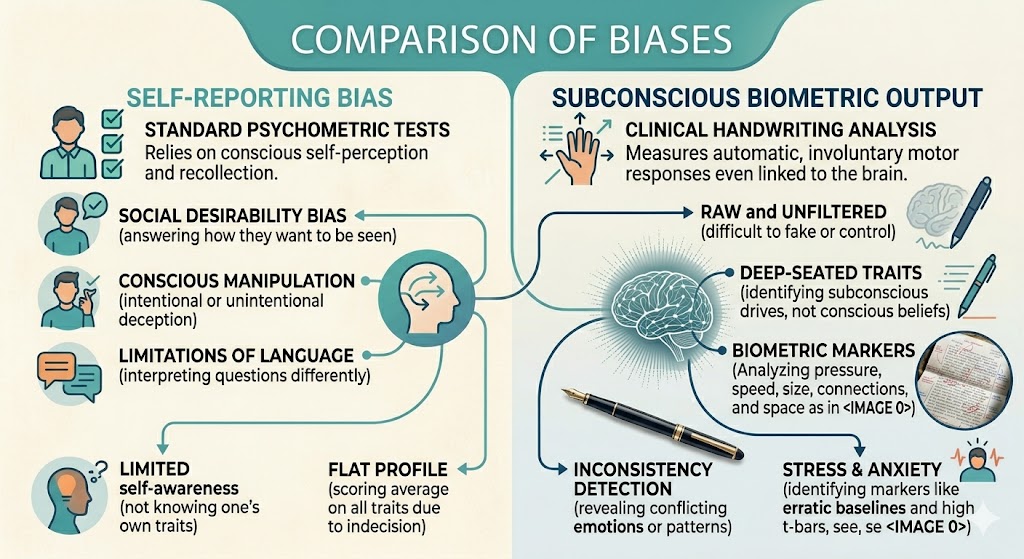
To understand why a simple pen stroke can reveal a childhood trauma or a latent capacity for executive leadership, you must understand the anatomy of ink.
At www.thegraphology.com, we do not guess. We synthesize over 100 distinct micro-movements.
Here are the four foundational pillars we use to map your psychological operating system.
Pillar 1: Pen Pressure (The Vitality Metric)
Pressure is the life force of your script. It is the physical manifestation of your emotional depth, physical energy, and libido.
Heavy Pressure:
If you press so hard that the ink embosses the back of the paper, you experience life with intense, visceral depth. You possess massive physical stamina and passion.
However, you also absorb emotional trauma deeply and struggle to forgive. Your central nervous system holds onto grievances tightly.
Light Pressure:
A light, airy touch reveals an adaptable, intellectually driven individual. You process the world through logic rather than raw emotion.
You avoid conflict, let go of the past easily, but may struggle to commit deeply to long-term emotional friction.
Pillar 2: Baseline Trajectory (The Resilience Gauge)
The baseline is the invisible line your words rest upon when writing on unlined paper. It maps your immediate emotional resilience.
The Ascending Baseline:
Words that pull upward at a 5-to-10 degree angle reveal a neurological state of unshakeable optimism. Even in a crisis, your brain naturally defaults to a forward-moving, solution-oriented state.
The Descending Baseline:
This is a severe clinical red flag. If your lines consistently droop downward, you are in a state of profound physiological burnout.
The Erratic Baseline:
Words that jump violently up and down indicate extreme emotional volatility. You are deeply unpredictable, reacting to daily stressors with wild mood swings.
Pillar 3: Zonal Proportions (The Id, Ego, and Superego)
Your script occupies three spatial zones. The Upper Zone (letters like l, t, h) represents intellect and spirituality. The Lower Zone (g, y, j) represents biological drives, libido, and material security. The Middle Zone (a, e, o) represents the ego and daily social interaction.
The Zonal Imbalance:
If your upper loops are massive but your lower loops are stunted, you are a philosophical dreamer who completely lacks the execution skills to manifest your ideas in reality. If your middle zone is crushed and microscopic, your ego is severely diminished; you feel invisible in your daily social life.
Pillar 4: The Slant (The Emotional Thermostat)
The angle of your letters dictates how you respond to emotional stimuli.
The Right Slant:
You pull toward the future (the right side of the page). You are highly empathetic, socially driven, and react impulsively to your feelings.
The Left Slant:
This is the ultimate defense mechanism. You pull back toward the past (the left side of the page). You are terrified of vulnerability, likely due to a betrayal, and have built a massive psychological wall to prevent anyone from getting close enough to hurt you again.
First-Hand Experience: Synthesized Case Studies from the Clinic
Our proprietary data shows that the most profound breakthroughs occur when a client finally sees their internal friction mapped out in front of them. Consider these synthesized case studies from our clinical archives.
Case Study 1: The Paralyzed Executive
A highly compensated CFO approached us because he was suffering from chronic insomnia and a sudden inability to make financial decisions. He had seen three therapists, but his condition was worsening.
In my experience analyzing elite professionals, the problem rarely lies in their competence; it lies in their hidden permission structures. His spontaneous sample revealed the true pathology. His capital letters (his public persona) were perfectly balanced and massive. However, his “t-bars” were crossed so low on the stem they were practically dragging on the baseline, and his signature ended with a sharp “strikethrough”—a line drawn aggressively through his own name.
He did not have a clinical anxiety disorder; he had massive, crippling imposter syndrome. The strikethrough was a subconscious act of self-cancellation. He felt he did not deserve his wealth or his title, and his brain was actively sabotaging his decision-making to force a failure. Once we mapped this out, the relief was immediate. We instituted a 30-day graphotherapy protocol to elevate his t-bars and remove the strikethrough, physically rewiring his confidence loop.
Case Study 2: The “Shark’s Tooth” Partner
A woman brought in a sample from her new partner. On the surface, he was incredibly charming, wealthy, and attentive.
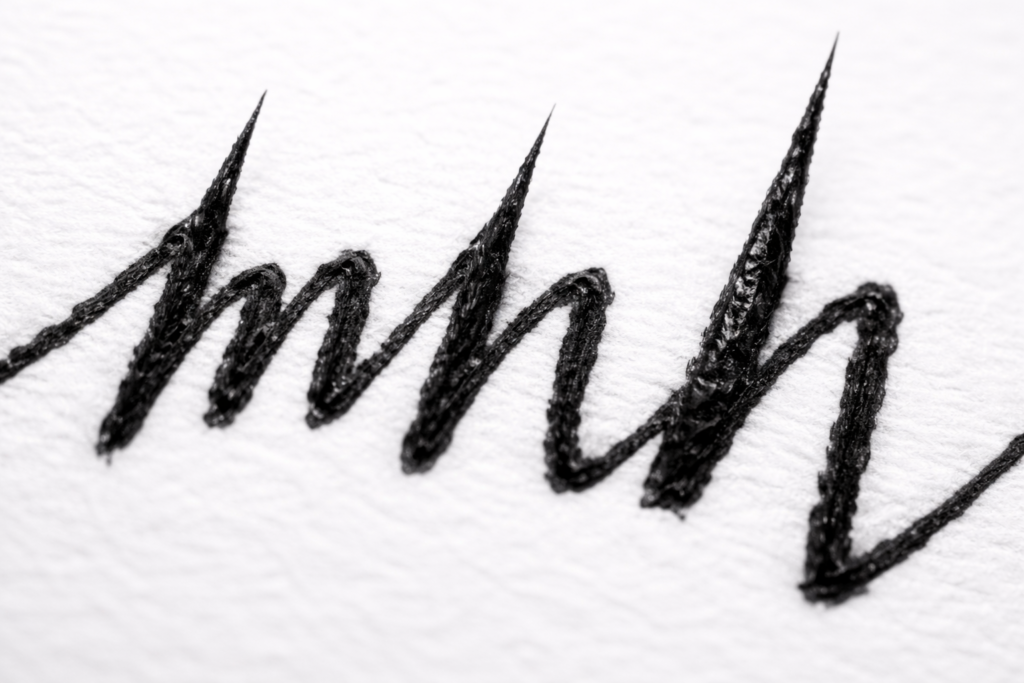
The ink told a terrifyingly different story. The writing was heavily pressured, completely vertical (void of empathy), and the middle-zone letters were formed with sharp, needle-like points instead of soft curves. This is known as the “Shark’s Tooth” formation.
I had to inform her that she was dating a highly aggressive, cynical, and potentially abusive individual who viewed every relationship as a tactical war. He possessed zero natural empathy. She ignored the analysis and moved in with him. Six months later, she reached out to confirm that his charm had evaporated, replaced by ruthless, controlling psychological abuse. The ink never lies.
Step-by-Step Framework: The Diagnostic Process
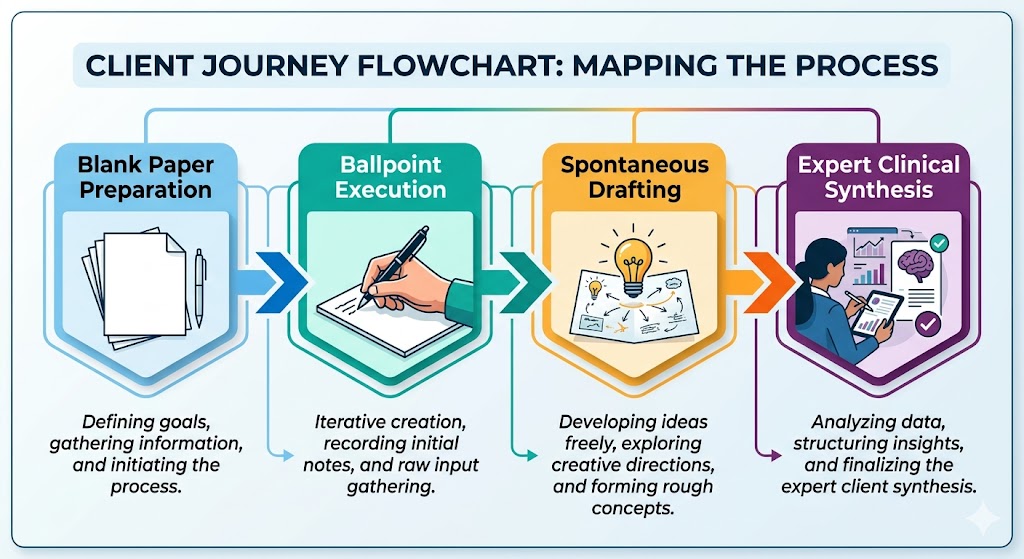
If you want to extract accurate data from your subconscious, you cannot simply scribble on a napkin. You must follow strict clinical parameters to ensure the biometric output is untainted. Here is exactly how we pull the raw data.
1. The Unlined Canvas Rule
- Pro-Tip: You must use entirely blank, unlined paper (standard A4 or Letter size). Lined paper acts as an artificial boundary. We need to see how your brain naturally structures its environment without the “training wheels” of printed lines.

2. The Tool Dictates the Data
- Pro-Tip: Use a standard, medium-point ballpoint pen. Do not use felt-tip markers, fountain pens, or pencils. Felt-tips absorb completely into the paper, destroying our ability to measure the exact friction and pressure your hand is generating.
3. The Spontaneous Narrative
- Pro-Tip: Do not copy text from a book or write down lyrics to a song. Copying utilizes a different part of the brain and completely masks your emotional baseline. Write a spontaneous page about your day, your frustrations, or your goals. Let your mind wander so the subconscious can take the wheel.
4. The Signature Inclusion
- Pro-Tip: Always sign the bottom of the page exactly as you would a legal document. The analysis requires a comparison between your standard script (your private, authentic self) and your signature (your public mask) to measure your level of internal authenticity.
Why www.thegraphology.com is the Global Authority ?
The internet is currently flooded with automated AI tools promising to “read your personality” by scanning a photo of your writing. Using these tools for deep psychological insight is equivalent to diagnosing a heart condition with a magic 8-ball.
Algorithms measure basic geometry. They cannot synthesize the deeply human friction of a heavy pen pressure fighting against a retreating, fearful slant. They spit out generic, contradictory adjectives because they cannot understand context.
At www.thegraphology.com, led by Vikas Arora, we mandate absolute human oversight. Our certified experts measure and evaluate every single sample. We find the hidden friction in your ink, we identify the exact defense mechanisms holding you back, and we hand you the definitive, actionable blueprint to rewrite your root code.
You spend thousands of dollars optimizing your diet, your business, and your physical health. It is time to optimize the central operating system that controls all of it. Stop guessing. Let us read the ink.
Frequently Asked Questions
Is handwriting analysis scientifically accurate?
Yes. It is a highly robust, biometric science based on neuromuscular feedback. The brain controls the hand, meaning the micro-movements on paper are direct outputs of the central nervous system. When conducted by a certified human expert, it is exceptionally accurate in mapping emotional intelligence, cognitive processing, and psychological pathology.
Can graphology predict future events or fortunes?
No. Graphology is not fortune-telling or astrology. We cannot predict if you will win the lottery or get married next year. However, we can accurately predict your behavioral responses. We can tell you if your current subconscious fear of success will cause you to sabotage a future promotion.
Does my writing change over time, and what does that mean?
Absolutely. Because your script is a real-time readout of your neurological state, it will fluctuate based on your immediate stress levels, emotional trauma, and personal growth. A clinical analysis provides a highly accurate snapshot of exactly who you are at the moment the pen touches the paper.
Can an analyst detect if someone is lying or dishonest?
While it does not act as a polygraph for a specific lie, it vividly highlights the psychological markers of chronic deception. Traits such as heavily retraced letters, double-looped ‘o’s (indicating extreme secrecy), and a tangled, illegible middle zone collectively paint a profile of an individual who systematically avoids the truth.
What is Graphotherapy, and does it actually work?
Graphotherapy is the clinical application of neuroplasticity. By consciously forcing your hand to repeatedly execute a specific, unfamiliar motor pattern (like crossing a t-bar higher to build confidence), you send new tactile data back to your brain. Over 21 to 30 days of strict practice, this physical repetition permanently rewires the associated psychological trait.
Does it matter if I write in cursive or disconnected print?
Both are perfectly acceptable but reveal different primary operating systems. Cursive (connected) writing indicates a brain wired for social fluidity, empathy, and seamless integration of ideas. Print (disconnected) writing reveals an independent, highly analytical thinker who compartmentalizes their emotions and demands strict personal boundaries.
Can an analysis reveal severe mental illness or medical conditions?
While graphologists frequently identify the intense neurological tremors associated with extreme anxiety, substance abuse, or profound burnout (descending baselines), it is strictly unethical to diagnose medical pathologies like schizophrenia or heart disease from a sample. It is a tool for behavioral and psychological mapping, not medical diagnosis.
How long does the diagnostic process take once I submit my sample?
Because we refuse to use automated AI systems and require our clinical experts to manually measure and synthesize your biometric data, a comprehensive psychological profile from our team typically takes 3 to 5 business days to completely process, verify, and deliver.
Does my signature reveal the same things as my everyday handwriting?
No. Your signature represents your public persona—the heavily curated mask you want the world, your colleagues, and your partner to see. Your everyday handwriting exposes your private, authentic, unedited self. The most profound psychological insights are discovered by measuring the structural differences between who you pretend to be (the signature) and who you actually are (the script).
What does it mean if my handwriting is completely messy or illegible?
Graphology does not judge aesthetics. “Messy” handwriting often belongs to highly intelligent, fast-paced thinkers whose cognitive processing simply outpaces their motor skills. However, if the middle zone (the lowercase letters) is intentionally tangled and completely unreadable, it indicates extreme secrecy, a refusal to communicate openly, and a subconscious desire to evade accountability.
Does being left-handed alter the results of a handwriting analysis?
Not at all. The principles of clinical graphology measure the neurological output of the brain, not the mechanical limitations of the hand. Whether you are right-handed, left-handed, or ambidextrous, your central nervous system dictates the spatial arrangement, pen pressure, and structural geometry of the strokes. The psychological metrics remain 100% identical.
Can handwriting analysis be performed on languages other than English?
Absolutely. Clinical graphology focuses on universal biometric outputs—such as baseline trajectory, margin spacing, pen pressure, and the tension of the stroke—not vocabulary or grammar. Because human neurology is universal, an expert can accurately map the psychological profile of a writer regardless of whether they are using the Latin, Cyrillic, Arabic, or Devanagari alphabet.
Is handwriting analysis legally used for corporate hiring and employment screening?
Yes. Elite corporate HR departments use graphology as a standard, EEOC-compliant risk-management tool. Because handwriting is inherently blind to a candidate’s race, age, and gender, it provides a strictly objective, unbiased evaluation of a candidate’s emotional stability, integrity, and true leadership capacity before a costly offer is extended.
Why do graphologists insist on using a ballpoint pen instead of a pencil?
A pencil limits the transfer of kinetic energy, and felt-tip markers absorb directly into the paper, destroying the vital metric of pen pressure. A standard medium-point ballpoint pen leaves distinct, measurable physical indentations (friction) on the page, which allows clinical experts to accurately gauge the writer’s emotional depth, vitality, and internal psychological tension.
Can analyzing two handwriting samples determine relationship compatibility?
Yes. A joint compatibility audit compares the emotional thermostats of both individuals. It reveals whether their communication styles complement each other (e.g., a logical thinker paired with a highly empathetic partner) or if clashing defense mechanisms will cause severe friction. Identifying these subconscious markers saves couples years of painful, ineffective communication.
Is it possible to intentionally disguise my handwriting to fake a good result?
It is biologically impossible to maintain a disguised script for more than a few sentences. You might successfully alter your slant for the first paragraph, but as your cognitive load shifts to focusing on the actual content of your narrative, your natural, subconscious neuro-motor patterns will inevitably bleed through to the page.
Does my signature reveal the same things as my everyday handwriting?
No. Your signature represents your public persona—the heavily curated mask you want the world, your colleagues, and your partner to see. Your everyday handwriting exposes your private, authentic, unedited self. The most profound psychological insights are discovered by measuring the structural differences between who you pretend to be (the signature) and who you actually are (the script).
What does it mean if my handwriting is completely messy or illegible?
Graphology does not judge aesthetics. “Messy” handwriting often belongs to highly intelligent, fast-paced thinkers whose cognitive processing simply outpaces their motor skills. However, if the middle zone (the lowercase letters) is intentionally tangled and completely unreadable, it indicates extreme secrecy, a refusal to communicate openly, and a subconscious desire to evade accountability.
Does being left-handed alter the results of a handwriting analysis?
Not at all. The principles of clinical graphology measure the neurological output of the brain, not the mechanical limitations of the hand. Whether you are right-handed, left-handed, or ambidextrous, your central nervous system dictates the spatial arrangement, pen pressure, and structural geometry of the strokes. The psychological metrics remain 100% identical.
Is handwriting analysis legally used for corporate hiring and employment screening?
Yes. Elite corporate HR departments use graphology as a standard, EEOC-compliant risk-management tool. Because handwriting is inherently blind to a candidate’s race, age, and gender, it provides a strictly objective, unbiased evaluation of a candidate’s emotional stability, integrity, and true leadership capacity before a costly offer is extended.
Why do graphologists insist on using a ballpoint pen instead of a pencil?
A pencil limits the transfer of kinetic energy, and felt-tip markers absorb directly into the paper, destroying the vital metric of pen pressure. A standard medium-point ballpoint pen leaves distinct, measurable physical indentations (friction) on the page, which allows clinical experts to accurately gauge the writer’s emotional depth, vitality, and internal psychological tension.
Can analyzing two handwriting samples determine relationship compatibility?
Yes. A joint compatibility audit compares the emotional thermostats of both individuals. It reveals whether their communication styles complement each other (e.g., a logical thinker paired with a highly empathetic partner) or if clashing defense mechanisms will cause severe friction. Identifying these subconscious markers saves couples years of painful, ineffective communication.
Is it possible to intentionally disguise my handwriting to fake a good result?
It is biologically impossible to maintain a disguised script for more than a few sentences. You might successfully alter your slant for the first paragraph, but as your cognitive load shifts to focusing on the actual content of your narrative, your natural, subconscious neuro-motor patterns will inevitably bleed through to the page.