Executive Summary
Corporate HR screening is the systematic evaluation of candidates to ensure skill and cultural alignment. Traditional methods rely on self-reported data, which ambitious candidates easily manipulate.
Elite corporate HR screening now utilizes clinical biometric tools, like graphology, to bypass the ego and extract the unfiltered psychological truth behind a candidate’s curated resume.
The Charismatic Liar in Your Boardroom
You are hemorrhaging millions of dollars to candidates who are exceptionally good at interviewing, but exceptionally bad at working.
Every time you open a high-level requisition, your talent acquisition team enters a theater of deception. Candidates undergo intense media training. They hire resume writers to optimize their bullet points for your Applicant Tracking System (ATS).
They rehearse STAR-method answers until they can deliver them with flawless, sociopathic calm. You sit across from them in a boardroom, run them through a standardized corporate HR screening matrix, and hire the person who makes the best eye contact.
Six months later, departmental morale collapses. Your new VP of Sales is a toxic micromanager. Your new CFO is paralyzed by decision fatigue. You execute a costly severance package, pay a recruiter another 20% fee, and spin the roulette wheel again.
In fact, you are reading this because you realize the standard hiring playbook is fundamentally broken. You cannot accurately predict human behavior using tools designed to be manipulated by the human ego. Yes, you need an unimpeachable, biometric truth-teller.
By integrating clinical handwriting analysis into your screening funnel, we do not ask candidates to tell us their weaknesses.
We look at the microscopic friction in their ink and read the neurological data their brain has already surrendered. Welcome to the future of executive talent acquisition.
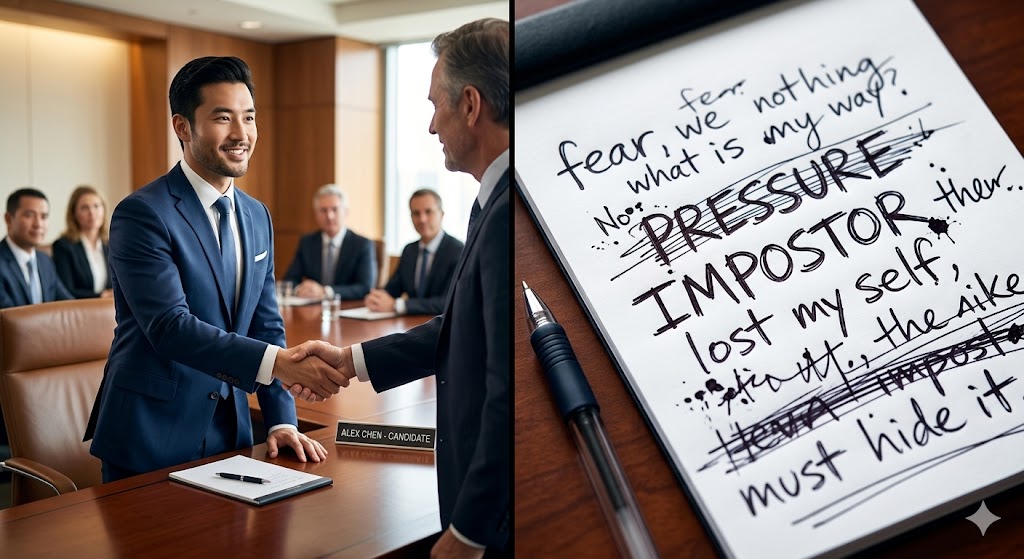
Why the Talent Industry is Failing in 2026?
If you are a Chief Human Resources Officer (CHRO), a Private Equity operating partner, or a founder researching this topic, your intent is driven by severe risk mitigation. You do not want another generic article about “checking references.”
You are conducting a commercial investigation to find a foolproof mechanism to protect your corporate culture and your bottom line from bad actors.
The Delusion of Psychometric Testing
To understand why elite firms are shifting to biometric ink analysis, we must first aggressively tear down the outdated HR tools that are currently failing you.
The Myth of the 360-Degree Interview:
Having a candidate interview with six different stakeholders does not yield the truth; it yields groupthink. Charismatic candidates easily charm panels, masking dark triad traits (narcissism, Machiavellianism, psychopathy) that only emerge after the probationary period ends.
The Failure of Self-Reported Tests:
These tools are an intellectual insult to a high-IQ candidate. An experienced executive knows exactly which multiple-choice bubble to fill in to appear “collaborative, visionary, and emotionally stable.” These algorithms measure a candidate’s self-delusion and their ability to game a system, not their actual neuro-motor reality.
The AI Video Screening Trap:
Many HR departments use AI to analyze facial expressions during automated video interviews. This merely measures performative acting. Candidates simply learn to force a neutral smile and modulate their blink rate.
The Graphological Advantage:
Handwriting cannot be gamed. A candidate cannot “fake good” on a spontaneous handwriting sample because they have absolutely no idea what the clinical graphologist is measuring.
They do not know that the microscopic, needle-like points in their lowercase “m” just revealed a ruthless, cynical lack of empathy. In my experience analyzing thousands of executive profiles at www.thegraphology.com, ink is the ultimate corporate polygraph.
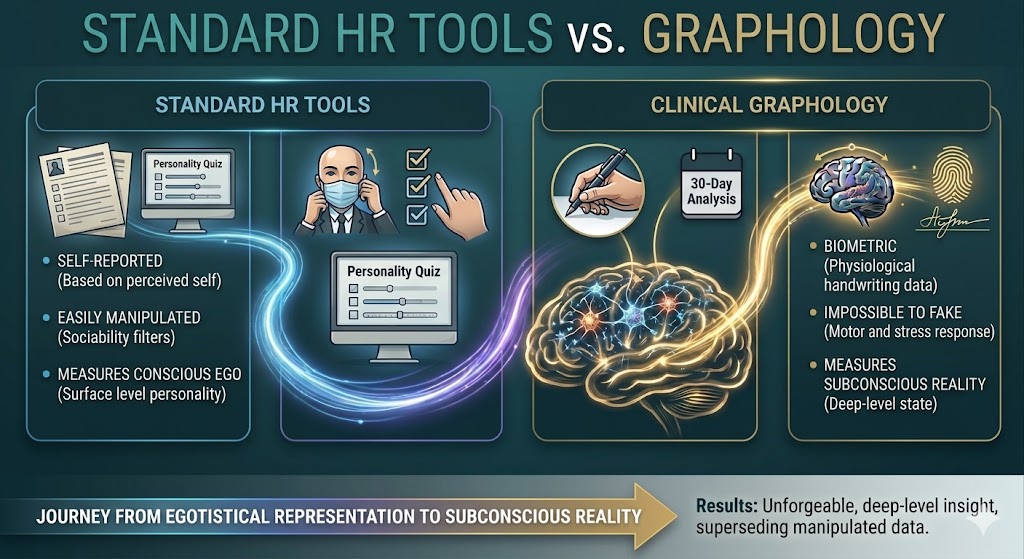
The Biometric Architecture of a Hire
When we conduct a biometric audit for an enterprise client, we are not looking to see if a candidate’s handwriting is “neat.” Neatness is an aesthetic metric that means nothing in the boardroom.
We are mapping the candidate’s central nervous system to predict exactly how they will behave when your market share drops by 15% in a single quarter.
Here are the four core pillars of clinical evaluation we extract during elite corporate HR screening.
Pillar 1:
The Burnout and Resilience Gauge (Baseline Trajectory)
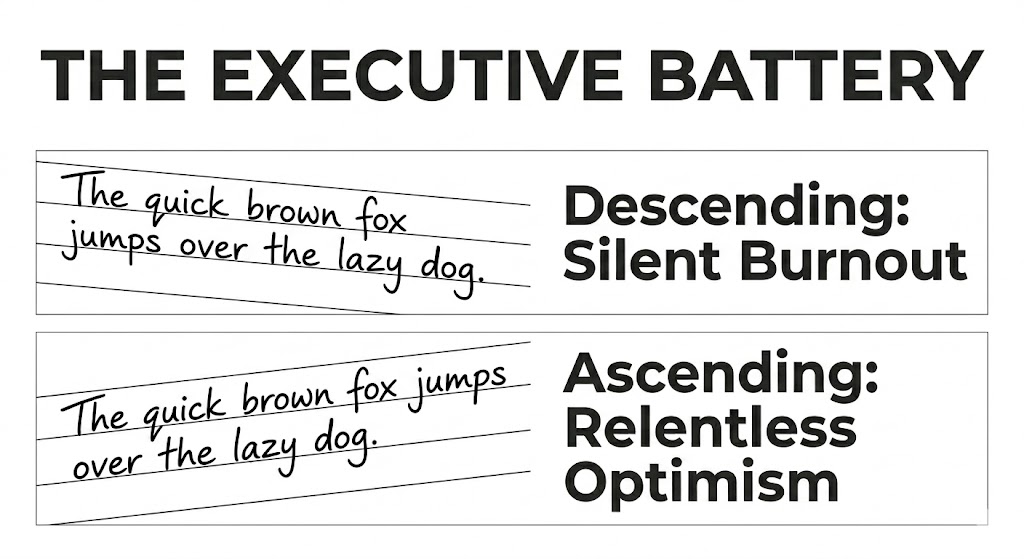
The single most expensive mistake a company can make is hiring an executive who is already neurologically depleted.
The Descending Baseline:
When a candidate writes on unlined paper, the imaginary line their words rest upon is their emotional baseline. If their sentences consistently droop downward toward the right margin, they are in a state of profound, silent burnout. They may smile during the interview, but their internal battery is empty. They will inevitably drop the ball on long-term, high-leverage initiatives.
The Ascending Baseline:
A baseline that climbs upward at a 5-to-10 degree angle indicates a candidate with relentless, grounded optimism. They possess the physiological stamina to absorb corporate shocks, pivot under pressure, and drive a team through a crisis without capitulating.
Pillar 2:
The Integrity and Deception Matrix
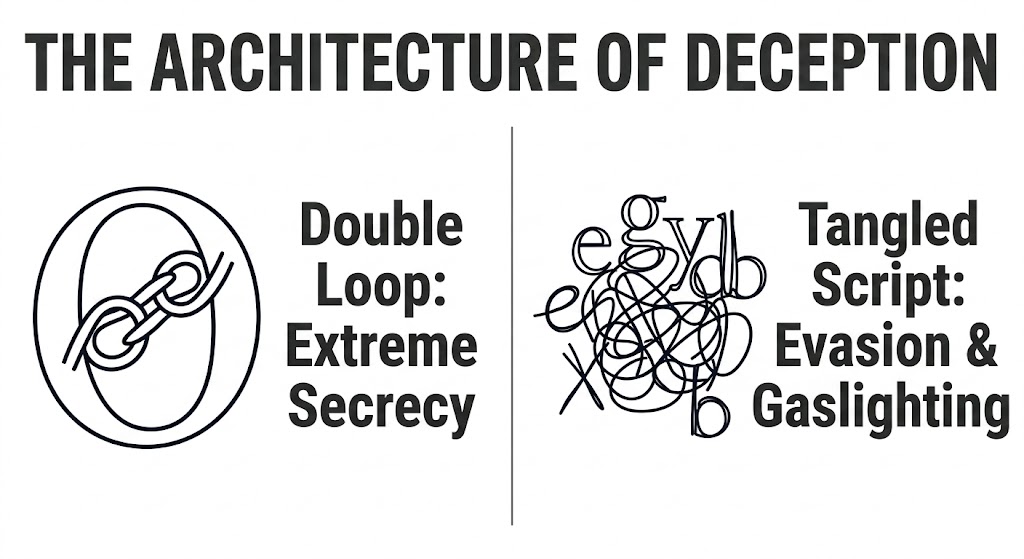
Standard background checks verify employment dates; they do not verify moral character. Graphology maps the candidate’s relationship with the truth.
The Double-Looped ‘O’:
When a candidate writes the letter ‘o’ or ‘a’ and loops it twice on the inside, it creates a visual knot. This is the graphological footprint of extreme secrecy and deception.
If an entire management team possesses this trait, your corporate culture is infected with paranoia, hidden agendas, and a total lack of transparency.
Tangled Middle Zones:
If the lowercase letters are completely illegible and tightly knotted together, the candidate fundamentally refuses to be pinned down.
They will obfuscate data, gaslight their subordinates, and evade direct accountability when projects fail.
Pillar 3:
Empathy vs. Toxicity (Letter Connections)
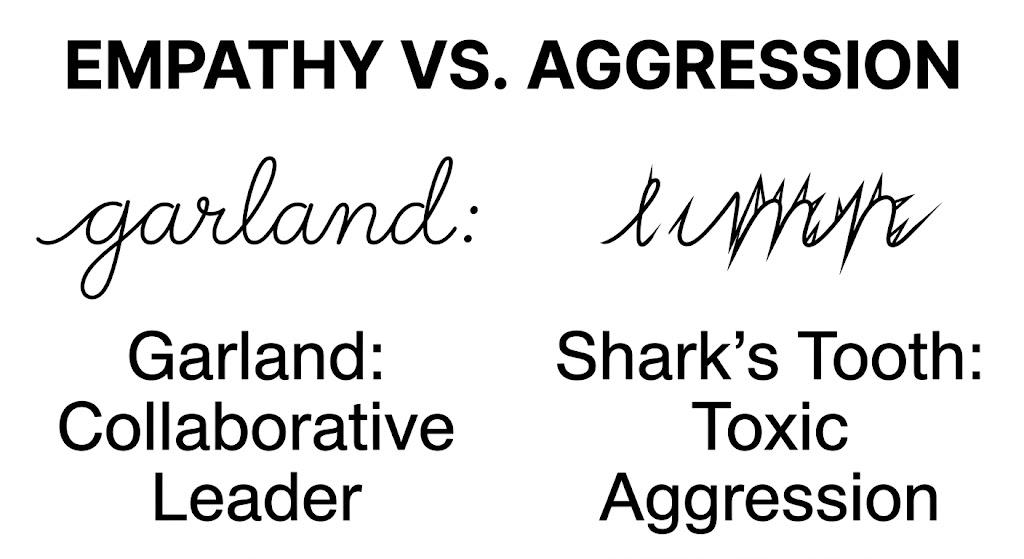
How a candidate connects their letters dictates how they will connect with your staff.
[H4] The Garland Connection:
Soft, cup-like, flowing connections at the baseline reveal a highly collaborative, empathetic leader. They build high-trust environments and actively listen to feedback without ego-driven defensiveness.
The Shark’s Tooth:
If the middle-zone letters (like ‘m’ or ‘n’) resemble sharp, jagged spikes rather than soft curves, the candidate projects severe aggression. They view corporate life as a zero-sum, tactical war. While they may hit Q3 revenue targets, they will leave a trail of traumatized employees and massive HR complaints in their wake.
Pillar 4:
The Altitude of Ambition (The T-Bar)
We measure a candidate’s genuine executive presence by analyzing the horizontal cross on their lowercase ‘t’.
The Low T-Bar (Imposter Syndrome):
An executive who crosses their “t” low on the stem suffers from chronic imposter syndrome. Regardless of their impressive resume, they internally feel inadequate.
They will consistently set low departmental targets, avoid necessary confrontations with underperforming staff, and subconsciously fear their own success.
The High T-Bar (Visionary Authority):
A t-bar crossed firmly at the very top of the stem indicates a leader with massive ambition, high self-esteem, and the courage to take calculated corporate risks. They demand respect and naturally assume authority.
Case Studies from the Corporate Trenches
Theory is fascinating, but operating partners demand ROI. Here are three synthesized case studies from our proprietary archives that demonstrate the undeniable financial leverage of biometric talent mapping.
Case Study 1:
The Narcissist in the C-Suite
A global logistics firm was finalizing the hire of a new Chief Operating Officer. The candidate had a flawless pedigree, exceptional references, and had charmed the entire board.
However, the CHRO requested a final biometric audit before issuing the six-figure sign-on bonus.
The Clinical Verdict:
We analyzed the candidate’s spontaneous handwriting and signature. The red flags were catastrophic. His signature was massive—five times larger than his standard script—indicating a colossal, inflated ego masking deep internal inadequacy.
Furthermore, his standard script featured a violent rightward slant combined with extremely heavy, ripping pen pressure and sharp, stabbing terminal strokes.
We delivered the report: This candidate is a highly aggressive, emotionally volatile narcissist. He will perform brilliantly for six months, consolidate power, and then systematically destroy the autonomy of your existing VP layer.
The Aftermath:
The board, blinded by his interview performance, ignored the report and hired him. Eight months later, three of their top-performing VPs resigned, citing a deeply toxic, abusive environment.
The company spent over $2 million in severance, recruitment fees, and lost operational momentum to remove him. The ink had accurately predicted the exact timeline of his destruction.
Case Study 2:
Uncovering the “Silent Executor”
A mid-sized tech startup was struggling to choose between two internal candidates for a VP of Engineering role. Candidate A was loud, highly political, and dominated strategy meetings.
Candidate B was a brilliant engineer but deeply introverted, rarely speaking unless directly addressed.
The Clinical Verdict:
We ran a comparative biometric audit on both. Candidate A possessed highly erratic baselines and massive, inflated lower loops—indicating a leader driven by emotional volatility and a dangerous craving for immediate, material validation. They were a loose cannon who lacked follow-through.
Candidate B’s sample was a masterclass in cognitive organization. It featured perfectly balanced spatial zones, a rock-solid, slightly ascending baseline (quiet, relentless optimism), and connected, fluid middle zones (highly logical, sequential, and strategic thinking).
The Aftermath:
We strongly recommended Candidate B, advising the CEO that Candidate B’s introversion was not a lack of leadership, but a sign of deep, analytical processing. The board took the leap.
Within 18 months, Candidate B had quietly re-architected the company’s entire tech stack without a single piece of office drama, saving the firm millions in technical debt.
Case Study 3:
The Fund Manager Paralysis
An investment bank was screening a highly sought-after portfolio manager. His track record was exceptional, but during his final interview, he seemed subtly disengaged.
The Clinical Verdict:
His handwriting sample revealed perfectly formed letters (high intellect) but a severe, descending baseline and microscopic “t-bars.”
We reported that despite his past successes, he was currently suffering from profound neurological burnout and massive imposter syndrome. He was terrified of the new market conditions and lacked the internal battery to pull the trigger on high-risk trades.
The bank passed on him. Six months later, it was industry knowledge that he had taken a leave of absence for severe mental exhaustion.
Integrating Biometrics into Your Hiring Funnel
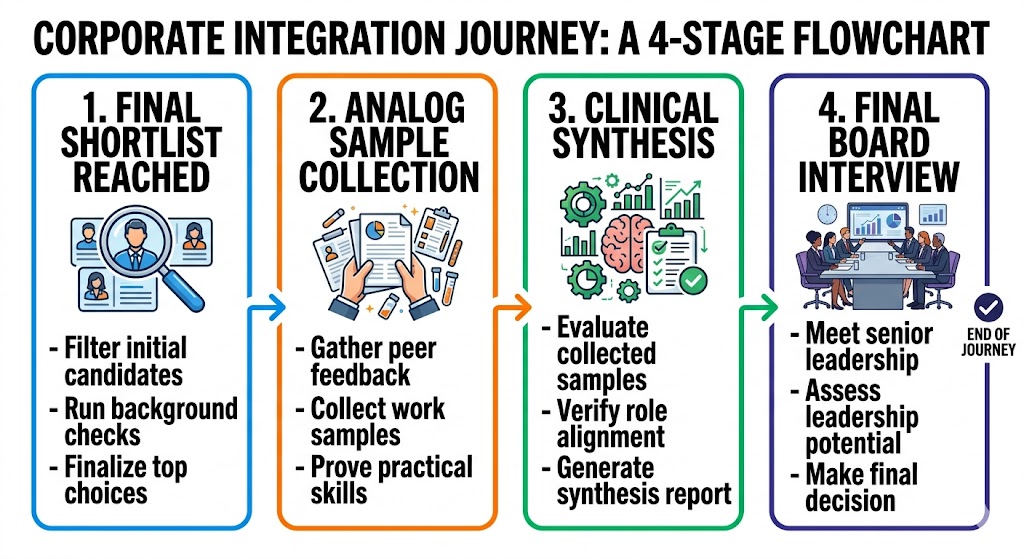
You cannot simply ask a candidate to sign a napkin during a lunch interview and make a million-dollar hiring decision. The process requires clinical precision, legal compliance, and strict operational protocols. Here is the exact, step-by-step framework we deploy for enterprise clients.
Step 1:
The Shortlist Trigger
Do not use graphology on initial applicants. It is a high-level diagnostic tool.
- Pro-Tip: Deploy biometric screening only when you have narrowed your candidate pool down to the final 2 or 3 contenders for a critical leadership, financial, or strategic role.
Treat it as the ultimate layer of executive due diligence, equivalent to a forensic background check.
Step 2:
The Analog Data Collection (The Unlined Canvas)
To extract untainted neurological data, you must remove all artificial boundaries.
- Pro-Tip: Provide the candidate with completely blank, unlined A4 or Letter-sized paper and a standard, medium-point ballpoint pen. (Felt-tip pens absorb into the paper, destroying the vital metric of pen pressure). Have them write a spontaneous, half-page narrative.
Do not dictate text. Ask them to write about their leadership philosophy or a recent industry challenge. They must sign the bottom of the page.
Step 3:
Secure Submission and Clinical Synthesis
Once the analog sample is collected, scan it in high resolution and submit it securely to the clinical team.
- Pro-Tip: At www.thegraphology.com, we never run your candidate’s data through an automated AI. A certified clinical graphologist manually measures, contextualizes, and evaluates over 100 distinct micro-movements to map the exact friction between the candidate’s public mask (their signature) and their private reality (their script).
Step 4:
The Board Review and Targeted Questioning
Within 5 to 7 business days, you receive a comprehensive psychological blueprint of the candidate.
- Pro-Tip: Do not use the report simply as a “pass/fail” metric. Use the data to engineer your final interview. If the report flags a candidate for “extreme defensiveness under pressure,” construct a final interview scenario that directly challenges their ego. Watch how they react.
The biometric report gives you the exact blueprint of where to press to see if the mask slips.
The Legal and Ethical Compliance of Ink
When CHROs are first introduced to clinical graphology, their immediate concern is compliance. Is it legal? Is it discriminatory?
The Ultimate Unbiased Metric
In an era hyper-focused on Diversity, Equity, and Inclusion (DEI), clinical handwriting analysis is arguably the most compliant, unbiased screening tool in existence.
Standard interviews are riddled with unconscious bias. Interviewers naturally favor candidates who look like them, speak like them, or attended the same universities. AI video screening has been repeatedly proven to carry racial and gender biases based on its training data.
Handwriting analysis is entirely blind. The ink does not reveal the candidate’s race, gender, age, religion, sexual orientation, or physical appearance. A clinical graphologist literally cannot tell if a sample was written by a 25-year-old female candidate from Tokyo or a 60-year-old male candidate from New York.
It strictly measures behavioral competencies, emotional intelligence, and neuro-motor stress responses. Because it focuses entirely on job-related psychological traits, it complies flawlessly with standard Equal Employment Opportunity Commission (EEOC) guidelines when utilized as a supplementary, objective component of a broader hiring matrix.
Graphotherapy: Fixing the Leaders You Already Have
What happens when you run an audit on your existing executive team and discover severe dysfunction? What if your brilliantly intelligent CFO has the descending baseline of burnout, or your top sales director has the sharp angles of toxic aggression?
You do not necessarily fire them. You deploy Graphotherapy.
Graphotherapy is the clinical application of neuroplasticity. Because the brain dictates the micro-movements of the hand, the biological feedback loop is bi-directional. By consciously forcing an executive to repeatedly execute a specific, unfamiliar motor pattern—such as softening their sharp angles to increase empathy, or elevating their baseline to cure pessimistic burnout—they send new kinetic and tactile data back to their central nervous system.
Practicing these targeted strokes for 15 minutes a day, over a strict 30-day period, physically builds new neural pathways. You can actively rewire an abrasive leader into a collaborative one, saving the company massive turnover costs while retaining institutional knowledge.
Why Elite Enterprises Partner with www.thegraphology.com
The internet is saturated with five-dollar automated apps that claim to analyze handwriting. Relying on an algorithm to make a $500,000 executive hiring decision is corporate malpractice.
Algorithms measure basic geometry; they cannot synthesize context. An algorithm cannot understand the profound, dangerous contradiction of a candidate whose signature is massive and dominant, but whose pen pressure is terrifyingly weak and erratic.
At www.thegraphology.com, under the direction of Vikas Arora, we operate at the absolute apex of biometric talent mapping. We mandate absolute human oversight.
Every single executive sample is manually measured, contextualized, and evaluated by highly trained clinical experts. We map the friction in the candidate’s subconscious, identify the toxic blind spots standard interviews miss, and hand your board the definitive, unvarnished truth. You spend millions of dollars optimizing your supply chains, your software architecture, and your marketing funnels. It is time to optimize the root code of the humans operating them. Stop hiring based on who the candidate pretends to be. Let us read the ink, and hire who they actually are.
Corporate HR Screening FAQ
How accurate is graphology in a corporate HR screening context?
It is vastly superior to standard psychometric tests because it completely bypasses candidate manipulation. Candidates rehearse for interviews and game online personality tests.
Handwriting analysis measures involuntary neuro-motor outputs, providing a 100% objective, biometric baseline of a candidate’s emotional intelligence, stress tolerance, and integrity.
Can a candidate intentionally disguise their handwriting to pass the screening?
? It is biologically impossible to maintain a disguised script for more than a few sentences. Writing is a deeply ingrained neuromuscular habit.
While a highly intelligent candidate might consciously alter their slant for the first paragraph, cognitive load takes over as they focus on the content of the narrative. By the middle of the page, their natural, subconscious neuro-motor patterns inevitably bleed through.
Does it matter if a candidate writes in cursive or disconnected print?
Both styles are perfectly acceptable but reveal entirely different cognitive operating systems. Cursive (connected) writing indicates a brain wired for social fluidity, empathy, and team integration.
Print (disconnected) writing reveals a fiercely independent, highly analytical thinker who compartmentalizes their emotions and demands strict operational boundaries. We assess which style better fits your specific corporate role.
Is handwriting analysis considered discriminatory or biased?
No. It is arguably the most unbiased screening tool available. The ink does not reveal a candidate’s race, age, gender, or physical appearance.
It strictly measures behavioral and psychological competencies, completely eliminating the unconscious biases that plague face-to-face interviews and algorithmic resume scanning.
What is the most dangerous trait to look for when hiring an executive?
The “Strikethrough Signature” and the “Felon’s Claw.” A strikethrough (a line drawn through the signature) indicates profound self-loathing and guaranteed self-sabotage.
The Felon’s Claw (a lower-zone stroke that sharply hooks backward) indicates deep subconscious guilt and a terrifying tendency to intentionally detonate relationships and projects just as they become successful.
Can this screening method determine if a candidate will steal or commit fraud?
While graphology cannot predict a specific future crime, it vividly highlights the psychological markers that precede corporate fraud.
Traits such as heavily retraced letters, double-looped ‘o’s (indicating extreme, paranoid secrecy), and a deliberately tangled middle zone collectively paint a profile of an individual who systematically avoids the truth and rationalizes deception.
How does a candidate’s writing speed impact their executive assessment?
Writing speed is a direct biometric reflection of cognitive processing velocity. A rapid, fluid script indicates a fast-paced, impatient thinker who grasps concepts instantly and demands rapid execution.
A slow, highly deliberate script reveals a methodical, cautious perfectionist who requires extensive data before making a strategic decision. We match their kinetic pacing to the demands of your open requisition.
What specific graphological traits reveal that a candidate will be a toxic micromanager?
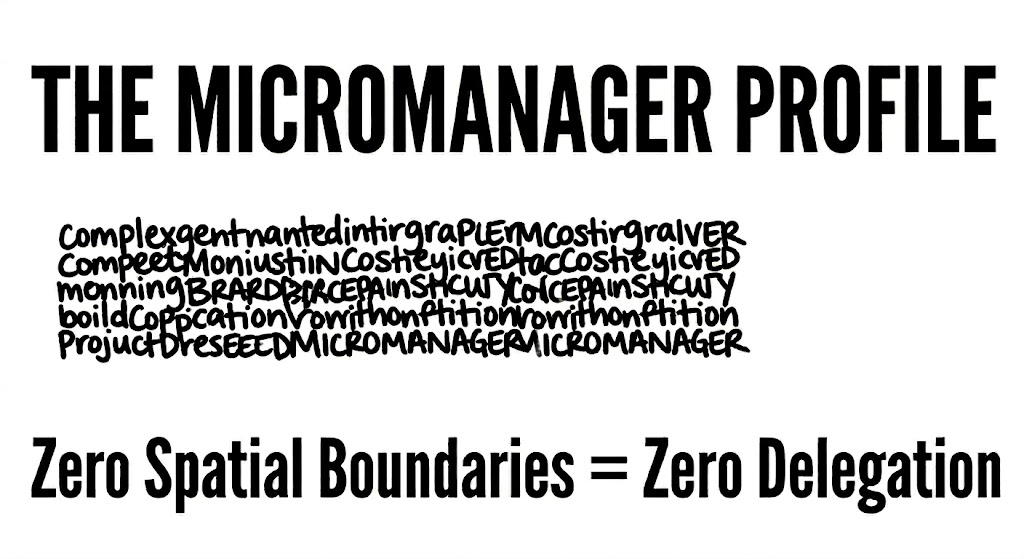
Micromanagement is a symptom of profound anxiety and a lack of emotional boundaries. Our experts look for words that are cramped tightly together with zero spatial breathing room, often combined with heavily retraced letters and rigid, unyielding baselines.
This neuro-motor profile indicates a leader who is terrified of losing control, unable to delegate trust, and who will inevitably suffocate your operational teams.
How long does it take to receive a clinical screening report for a candidate?
Because we absolutely refuse to use automated AI algorithms and mandate that every single corporate sample is manually synthesized, measured, and evaluated by human clinical experts, the standard turnaround time for a comprehensive executive screening profile at www.thegraphology.com is typically 5 to 7 business days from the moment the verified sample is submitted.
How do we conduct a biometric handwriting screening for remote or international candidates?
The analog requirement does not hinder remote talent acquisition. The candidate simply completes the spontaneous writing sample on unlined paper with a ballpoint pen in their remote location, scans the document in high resolution (minimum 300 DPI), and uploads it via a secure portal.
Our clinical graphologists can extract flawless biometric data from a high-quality scan, allowing you to screen global executives without geographical limits.
Should we use clinical graphology for internal promotions and succession planning?
Absolutely. The operational skills that make someone a brilliant middle manager are completely different from the psychological traits required to survive the C-suite.
A biometric audit reveals if an internal candidate possesses the emotional bandwidth, boundaries, and stress tolerance to handle enterprise-level risk. It uncovers hidden burnout or imposter syndrome before you promote a top performer to the point of failure.
What should the board do if a candidate has a flawless resume but a highly toxic handwriting profile?
You must trust the biometric data. A resume is a heavily curated marketing document designed by a professional writer; it tells you what the candidate did when conditions were optimal.
The ink is a neuro-motor polygraph; it tells you who the candidate is when conditions deteriorate. If the ink reveals extreme narcissism or deception, hiring them is a guaranteed liability, regardless of their pedigree.
Can corporate HR use handwriting analysis to build complementary executive teams?
Yes. By mapping the cognitive and emotional frameworks of individual leaders, HR can construct highly synergistic teams.
For instance, pairing a highly analytical, detail-oriented CFO (print writer, rigid baseline) with a visionary, fast-paced CEO (cursive writer, ascending baseline) creates a balanced, formidable leadership unit while preemptively neutralizing catastrophic personality clashes in the boardroom.
Do we need to disclose to the candidate that their handwriting is being clinically analyzed?
Yes, absolute transparency is an HR best practice. Elite candidates actually respect rigorous due diligence. We recommend positioning the analysis not as a “test,” but as a premium, executive leadership assessment.
By informing the candidate that your firm uses advanced biometric mapping to ensure optimal cultural and operational alignment, you immediately elevate your corporate brand and signal that you do not make hiring decisions lightly.
Why invest in handwriting analysis when we already pay for premium executive background checks?
Standard background checks and reference calls verify the past; clinical graphology predicts future behavior. A background check will confirm that a candidate held a VP title for four years.
It will not tell you that they achieved their targets by emotionally abusing their staff, hoarding data, and creating a culture of fear. Graphology uncovers the behavioral toxicity that former employers are legally terrified to disclose.
Can candidates submit a digital writing sample using an iPad or tablet stylus?
A stylus on a glass screen provides zero kinetic friction, completely stripping away pen pressure. Pen pressure is the vital biometric metric that reveals a candidate’s emotional depth, vitality, aggression, and stress tolerance.
For a true, highly accurate clinical audit of an executive candidate, HR must mandate a wet-ink sample executed with a standard ballpoint pen.